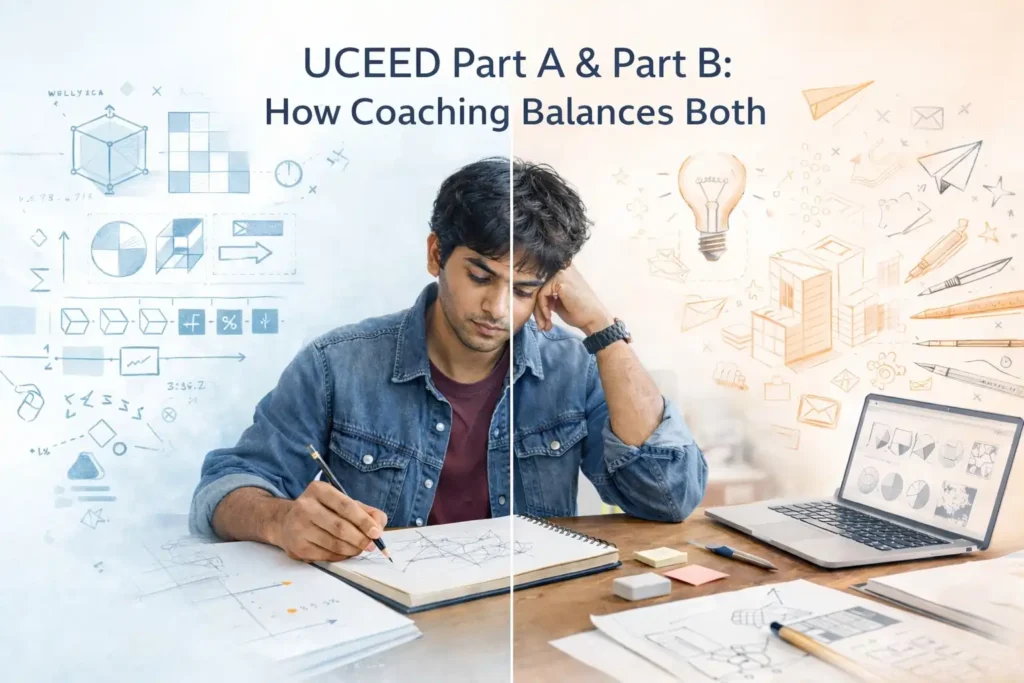
Preparing for UCEED is not just about studying harder – it’s about preparing smarter. Many aspirants quickly realize that UCEED Part A and Part B demand two entirely different skill sets. One tests analytical aptitude and logical reasoning, while the other evaluates visualization skills, observation skills, and perspective drawing. This contrast creates a preparation gap, especially for students without prior design exposure.
The real challenge isn’t difficulty – it’s balance. Students often excel in one section but underperform in the other. This article explains why that happens and how a structured learning framework can systematically bridge the gap.
Understanding UCEED Exam Structure
The Undergraduate Common Entrance Examination for Design is conducted by Indian Institute of Technology Bombay to assess a candidate’s readiness for design education. The exam evaluates both analytical intelligence and creative thinking through two distinct sections:
- Part A – Computer-based aptitude evaluation
- Part B – Drawing and design expression assessment
Success depends on mastering both rather than specializing in one.
What is UCEED Part A?
UCEED Part A is a computer-based section that tests logical reasoning, spatial reasoning, observation skills, visualization skills, and analytical aptitude through objective questions. It evaluates how well a student can analyze patterns, interpret data, and solve problems quickly and accurately under timed conditions.
What is UCEED Part B?
UCEED Part B is a subjective drawing and design section that assesses creativity, perspective drawing, design thinking ability, and problem-solving through sketches and visual responses. It measures originality, composition, and clarity of ideas rather than artistic perfection.
Key Differences Between Part A & Part B
| Aspect | Part A | Part B |
| Mode | Computer-based | Offline drawing |
| Skills Tested | Logical reasoning, spatial reasoning | Perspective drawing, creativity |
| Question Type | Objective | Subjective |
| Evaluation | Automated scoring | Examiner evaluation |
| Preparation Style | Practice + analysis | Studio practice + feedback |
| Time Pressure | High | Moderate but conceptual |
What is the Weightage of Part A and Part B in UCEED?
While exact marks distribution can vary by year, Part A carries the majority weightage, acting as the primary screening section. Only candidates who qualify Part A have their Part B evaluated. This makes UCEED Part A and Part B strategically linked: Part A determines eligibility, while Part B determines rank quality.
Why Students Struggle to Balance Both
Balancing UCEED Part A and Part B is difficult because they require opposite cognitive approaches. Part A demands speed, accuracy, and logic, whereas Part B needs creativity, imagination, and expression. Most students naturally excel in only one domain, leading to uneven preparation and lower overall scores.
How Coaching Creates the Balance
1. Structured Curriculum
A strategic preparation framework divides study time between aptitude and creativity. Instead of random practice, students follow an integrated learning model combining:
- Logical reasoning drills
- Visualization exercises
- Design sketch sessions
- Timed practice tests
2. Faculty Feedback
Unlike self-study, guided preparation includes expert evaluation. Faculty identify:
- Weak observation skills
- Composition mistakes
- Perspective errors
- Logical reasoning gaps
Feedback accelerates improvement cycles.
3. Tailored Feedback for Part B
Drawing improvement requires personalized critique. Structured coaching provides:
- Line quality corrections
- Concept clarity guidance
- Composition enhancement
- Idea originality suggestions
This type of correction is nearly impossible without expert review.
4. Strategic “Part A First” Approach
Many institutes recommend clearing Part A proficiency first because:
- It determines qualification eligibility.
- Logical skills improve faster with practice.
- Confidence increases after mastering objective questions.
Once Part A becomes stable, attention shifts to refining Part B creativity.
5. UCEED Mock Test Strategy
An effective UCEED mock test strategy follows a loop:
Mock → Analysis → Correction → Retest
Students who regularly analyze mocks improve faster than those who simply attempt them.
6. Time Division Model
Two proven preparation ratios:
60-40 Model
- 60% time → Part A
- 40% time → Part B
70-30 Model (for beginners)
- 70% → Aptitude foundation
- 30% → Drawing basics
These ratios adjust as proficiency improves.
7. Balancing Approach
To master UCEED Part A and Part B, preparation must develop:
- Creative + analytical synergy
- Speed + clarity
- Logic + imagination
Balanced preparation always outperforms single-skill specialization.
How to Prepare for UCEED Part A?
Focus on accuracy, speed, and reasoning depth.
Step-by-step method
- Build logical reasoning foundation.
- Practice spatial reasoning questions daily.
- Solve timed quizzes.
- Review mistakes after each session.
- Track accuracy percentage.
UCEED time management tips
- Attempt easy questions first.
- Skip time-consuming puzzles.
- Allocate fixed time per section.
- Keep last minutes for review.
How to Prepare for UCEED Part B?
Part B preparation is about creative clarity, not artistic perfection.
Practice framework
- Daily sketch exercises
- Object observation drawing
- Perspective practice
- Visual storytelling tasks
- Concept-based sketch prompts
Studio practice essentials
- Draw from real objects
- Practice quick thumbnails
- Work with time limits
- Analyze model answers
Sample Weekly Study Plan
| Day | Focus Area | Practice Type |
| Monday | Logical reasoning | Timed quiz |
| Tuesday | Drawing fundamentals | Perspective sketches |
| Wednesday | Visualization skills | Spatial puzzles |
| Thursday | Design thinking ability | Creative prompts |
| Friday | Mock test | Full-length |
| Saturday | Analysis | Error review |
| Sunday | Revision | Weak topics |
Expert Tips to Crack Both Sections
- Give equal importance to both UCEED Part A and Part B.
- Practice drawing daily even if for 20 minutes.
- Analyze every mock test thoroughly.
- Improve observation skills by sketching real-life scenes.
- Strengthen spatial reasoning through puzzles.
- Focus on concept clarity over speed in Part B.
- Build creative problem solving ability through idea exercises.
Strategic Framework for Mastery
Performance Tracking Approach
Maintain a progress log including:
- Accuracy percentage (Part A)
- Sketch evaluation score (Part B)
- Mock test rank trend
- Weak topic list
Tracking converts preparation into measurable improvement.
Integrated Learning Model
High performers follow a blended approach:
- Analytical drills + creative exercises
- Timed practice + open-ended sketching
- Mock tests + studio practice
This model ensures balanced growth.
FAQs
What score is considered good in UCEED Part A?
A good score usually falls within the top qualifying percentile for that year. Since Part A determines whether Part B is evaluated, scoring above the cutoff with strong accuracy significantly improves chances of a competitive rank.
Can I clear UCEED in 2 months?
Yes, but only with an intensive and strategic preparation plan. Focus on high-weightage aptitude topics, daily drawing practice, and frequent mock tests. Short timelines require disciplined scheduling and consistent performance analysis.
How to prepare for UCEED Part B?
Practice daily sketching, perspective drawing, and concept visualization. Focus on clarity of ideas, proportion accuracy, and composition. Review sample answers and get feedback whenever possible to refine technique.
How to prepare for UCEED Part A?
Solve aptitude questions regularly, analyze mistakes, and improve speed gradually. Prioritize logical reasoning, spatial reasoning, and observation-based questions. Timed practice is essential for accuracy under exam pressure.
Conclusion: Balanced Preparation is the Real Advantage
The biggest mistake aspirants make is treating UCEED Part A and Part B as separate challenges. In reality, success comes from mastering their combination. One evaluates logic; the other tests creativity. Together, they measure design potential.
Students who follow a strategic preparation plan – combining structured practice, mock analysis, and guided improvement – develop both analytical sharpness and creative confidence. This balanced approach not only improves scores but also builds the mindset required for design education.