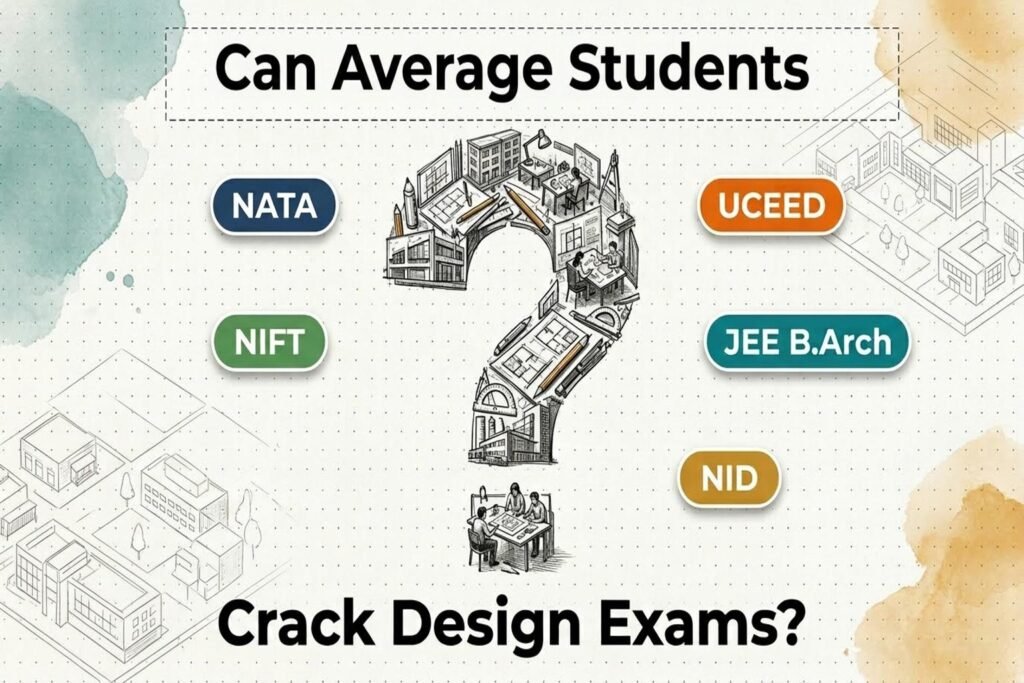
“My board marks are average. I am not from a big city. Is a career in design even possible for me?” – If this thought has ever crossed your mind, you are not alone. Thousands of students from Madhya Pradesh and across Central India ask this every year. The answer – backed by hundreds of real selections – is a resounding YES.Every year, students ask – can average students crack NATA ? , NIFT, UCEED, or JEE B.Arch with just 60–70% in their boards? The answer is yes – and hundreds of them walk nto design colleges like NID, NIFT, UCEED-accepting IITs, and top architecture schools every single year – not because they were born talented, but because they prepared the right way. This guide is your honest, no-fluff roadmap.
Can average students crack NATA, NIFT, UCEED, or JEE B.Arch? Let us find out – exam by exam, step by step.
The Honest Answer: Yes – But Here Is What “Average” Really Means in Design Exams
Yes, average students can absolutely crack NATA, NIFT, UCEED, and JEE B.Arch. Unlike JEE (Main) or NEET, design entrance exams test creative aptitude, observation, spatial reasoning, and drawing ability – not rote academic performance. A student with 65% in boards can outperform a 90-percenter if they have trained their design thinking and visual skills systematically.
Here is the key insight most students miss: the word “average” means different things in different exam contexts. In design exams, your percentile in PCM has very little bearing on your final rank. What matters is how well you understand space, form, colour, and visual logic – all of which can be developed with structured practice.
Did You Know?
In NATA 2024, over 60% of candidates who qualified in the top 5,000 had board percentages below 75%. Design aptitude is a trained skill, not a birthright.
What holds students back is not their marks – it is the wrong preparation approach. Students who skip design aptitude test preparation or who never build a drawing practice routine are the ones who struggle. The ones who prepare smart – with good mentorship, the right design entrance exam coaching institute, and consistent mock tests – almost always make it.
Also Read :- Why Some Creative Students Still Fail in Design Entrance Exams (And How to Fix It)
Which Design Entrance Exam Is Right for You? (NATA vs NIFT vs UCEED vs JEE B.Arch)
Before you start preparing, you need to know which exam aligns with your career goals. Here is a clear comparison:
| Exam | Full Form | Career Path | Difficulty | Attempts |
| NATA | National Aptitude Test in Architecture | B.Arch – top architecture colleges | Moderate | Unlimited |
| NIFT | National Institute of Fashion Technology | Fashion Design, Communication Design | Moderate | Unlimited |
| UCEED | Undergraduate Common Entrance Exam for Design | B.Des at IIT Bombay, IIT Delhi | High | 2 max |
| JEE B.Arch | JEE (Main) Paper 2 – Architecture | B.Arch at NITs, SPAs | High | 3 attempts |
| NID DAT | National Institute of Design – DAT | B.Des at NID Ahmedabad, Bangalore | Very High | Unlimited |
NATA: Can Average Students Crack It?
Can average students crack NATA? Absolutely. NATA is one of the most democratically designed entrance exams in India. It tests three core areas: Drawing, Mathematics, and General Aptitude. The drawing section rewards students who have practiced observation, perspective, and creativity – not those who scored high in school.
Key things to know about NATA:
- There is no fixed number of attempts – you can appear multiple times in a single year.
- The NATA eligibility requires passing Class 12 with Physics, Chemistry, and Maths with at least 50% aggregate.
- NATA scores are accepted by over 1,100 architecture colleges across India.
- The drawing paper (125 marks) is where most average students win or lose – targeted practice makes the biggest difference.
Did You Know?
NATA 2025 will have two sessions. Students who appear in both and take the best score can significantly improve their chances – even if the first attempt does not go as planned.
For students from Bhopal and Indore preparing for NATA, joining a good NATA coaching in Bhopal institute gives access to structured drawing feedback, mock tests, and mentorship from faculty who know the exam inside out.
NIFT Entrance Exam: Is It Achievable for Average Students?
The NIFT eligibility and selection process is different from other design exams. NIFT has two stages: a Creative Ability Test (CAT) and a General Ability Test (GAT), followed by a Situation Test for shortlisted candidates. The good news? The GAT syllabus is well-defined and can be cracked with 4–6 months of consistent preparation.
For average students, NIFT is often the most accessible top-tier design entrance because:
- There is no negative marking in most sections.
- The CAT heavily rewards creative thinking and ideation – skills that are trainable.
- The Situation Test is a hands-on 3D model-making task, which most coached students are well-prepared for.
If you are looking at NIFT coaching for average students in Central India, look for institutes that give dedicated time to CAT portfolio practice and situation test mock rounds.
UCEED 2025–26: A Realistic Timeline for Average Students
Can I crack UCEED in 6 months? Yes – but UCEED is the most demanding of the lot. Conducted by IIT Bombay, UCEED tests visual perception, analytical reasoning, creativity, and design sensitivity. It is a purely objective exam (MCQs + numerical questions).
Strategy Tip for UCEED:
UCEED has only 2 attempts lifetime. Start at least 10–12 months before the exam. Use the first 4 months to build your observation journal (sketch something new every day), the next 4 months for full syllabus coverage, and the last 2–4 months exclusively for UCEED mock test series online.
Students who enrol in a structured UCEED coaching institute in Bhopal benefit enormously from curated topic lists, weekly design challenges, and peer learning environments that solo preparation cannot replicate.
JEE B.Arch: What Percentage Do You Actually Need?
For JEE B.Arch, you need a minimum of 75% in Class 12 (or be in the top 20 percentile of your board). For NATA, the requirement is 50% aggregate in PCM. This means students with moderate board scores are still well within eligibility for NATA.
JEE B.Arch Paper 2 has three parts: Mathematics (100 marks), Aptitude (200 marks), and Drawing (100 marks). The drawing section is your biggest opportunity if you have trained well. JEE B.Arch coaching in Indore is increasingly in demand from students across Madhya Pradesh targeting NITs and SPAs.
Design Career Options After 12th in India: What Can You Actually Do?
One major reason students hesitate to pursue design is that they are unsure of where it leads. Here is a look at the wide range of design career options after 12th in India:
| Design Field | Relevant Exam | Starting Salary Range | Growth |
| Architecture | NATA / JEE B.Arch | ₹3–6 LPA | High |
| Industrial Design | UCEED / NID DAT | ₹4–8 LPA | Very High |
| Fashion Design | NIFT | ₹3–6 LPA | Moderate–High |
| Communication Design / UX | UCEED / NID / NIFT | ₹5–12 LPA | Very High |
| Textile & Accessory Design | NIFT | ₹2.5–5 LPA | Moderate |
| Animation / Game Design | NID / CEED after graduation | ₹4–10 LPA | High |
Top design colleges accepting NATA scores include SPA Delhi, CEPT Ahmedabad, NIT Calicut, NIT Trichy, and over 1,000 private and government architecture schools. For NIFT, 16 campuses across India – including Delhi, Mumbai, Chennai, and Hyderabad – await qualified students.
How to Prepare for Design Entrance Exams as an Average Student
The 1 mistake average students make? Treating design preparation like board exam preparation – reading notes and memorising facts. Design exams reward doing, not just knowing. Here is a proven four-step approach:
Step 1 – Master the Syllabus Before You Do Anything Else
The NATA syllabus for 12th pass students includes three broad areas: mathematical reasoning, general aptitude (objects, texture, spatial relationships), and drawing (2D/3D compositions, perspectives, memory drawing). Many students waste months preparing the wrong topics. Download the official syllabus, map it against what you already know, and identify your weakest areas first.
Step 2 – Build Creative Thinking and Drawing Skills Daily
You do not need to be a “natural artist.” What you need is a daily habit. Spend at least 30–45 minutes every day on drawing, sketching objects around you, and practising perspective. Creative thinking skills for entrance exams like UCEED and NID are built over months of consistent observation journaling – sketching what you see, asking why things are designed the way they are.
For portfolio building for design colleges like NID and NIFT, start early – at least 6 months before the exam. Your portfolio should show range: 2D compositions, typography exercises, product sketches, and observational drawings.
Step 3 – Use the Right Study Materials and Mock Tests
Here are the most trusted resources for each exam:
| Exam | Recommended Resources | Where to Find |
| NATA | NATA study material PDF by CoA guidelines, B.V. Doshi sketching books | CoA official site, coaching institutes |
| UCEED | UCEED preparation books 2025 by IIT Bombay, past year question papers | IIT Bombay UCEED portal |
| NIFT | NIFT notes for fashion communication, GK + current affairs compendium, CAT practice sets | Coaching institutes, design forums |
| JEE B.Arch | JEE B.Arch drawing practice papers, Aptitude by P.K. Mishra | Online platforms, coaching study kits |
| NID | NID design aptitude study guide, visual culture books | NID official prep, specialist coaching |
Alongside books, use UCEED mock test series online and NATA mock tests available through coaching platforms. Timed mock tests – especially in the final 8 weeks – are the single most effective preparation tool.
Step 4 – Coaching vs. Self-Study: What Works Better?
Here is an honest comparison:
| Factor | Self-Study | Coaching Institute |
| Drawing feedback | Hard to self-evaluate | Expert daily critique |
| Mock tests | Limited & unstructured | Structured, exam-pattern aligned |
| Motivation & accountability | Varies by student | Peer group & mentorship |
| Cost | Low | Varies by institute |
| Study material quality | Depends on sources | Curated & updated yearly |
| Results (track record) | Inconsistent | Proven with AIR rankers |
If you are a self-starter with access to good online resources, self-study can work for NATA and NIFT. But for UCEED and NID – where competition is significantly sharper – structured guidance from a design entrance exam coaching institute makes a measurable difference.
Also Read :- What Industry Demand Says About Design Careers in India (2026 Data)
Best Design Entrance Exam Coaching in Central India (Bhopal & Indore)
Students from smaller cities often worry that they cannot compete with aspirants from metros. But here is the truth: the best design entrance exam coaching in Madhya Pradesh produces results that rival any Delhi or Mumbai institute – often at significantly lower fees and with far more individual attention.
When evaluating a NATA coaching in Bhopal or NIFT coaching in Indore institute, look for these non-negotiable criteria:
- Track record – How many AIR Top 100 selections have they produced? Ask for verifiable results, not just claimed numbers.
- Faculty expertise – Are the faculty working professionals or designers themselves?
- Mock test frequency – At least one full-length mock test per week in the final three months is a minimum standard.
- Personalised drawing feedback – This is non-negotiable. Generic classroom instruction will not improve your drawing score.
- Updated study material – The exam pattern evolves yearly. Stale material from 2020 will not cut it in 2026.
Did You Know?
Design Aspirants, based in Bhopal and Indore, has produced 850+ selections across NID, NIFT, UCEED, NATA, and JEE B.Arch – including multiple All India Rank holders – making it one of Central India’s most trusted design entrance exam coaching institutes.
Why Tier-2 City Students Actually Have an Advantage
Students from cities like Bhopal, Indore, Jabalpur, and Gwalior often develop stronger observational skills simply because they interact with diverse, real-world environments daily – markets, traditional architecture, craft fairs. These lived experiences translate directly into richer drawing memory and better scores in design aptitude test preparation.
The online NATA preparation course options and hybrid coaching models available today also mean that geography is no longer a barrier. Students from Madhya Pradesh can access the same quality of preparation that was once only available in metro cities.
Also Read :- What Makes Design Aspirants the Best NID Coaching for 2026 Preparation
Frequently Asked Questions by Average Students About Design Exams
Q1. Can an average student get into NID?
Yes. NID coaching for beginners exists precisely because NID‘s entrance – the Design Aptitude Test (DAT) – is not a measure of academic performance. It tests creativity, material sensitivity, and design thinking. Students with average boards but strong aptitude training regularly clear the DAT Prelim and Mains. Consistent preparation over 12–18 months is the key differentiator.
Q2. Is NIFT easier than UCEED?
Generally yes – NIFT is considered more accessible than UCEED. UCEED is conducted by IIT Bombay and selects only about 250–300 students nationally, making it extremely competitive. NIFT, by contrast, has 16 campuses and admits several thousand students annually. However, “easier” is relative – the CAT in NIFT requires serious creative practice. The right NIFT coaching for average students makes both achievable.
Q3. How many attempts are allowed for NATA?
There is no limit on the number of NATA attempts. Students can appear multiple times within a single year across different sessions. The Council of Architecture (CoA) typically conducts NATA two or three times per year. Your best score across attempts is considered by most colleges. This makes NATA one of the most forgiving design entrance exams for average students.
Q4. Which design exam is best for average students?
For average students, NATA and NIFT are the most accessible starting points. NATA has no attempt cap and tests a relatively structured syllabus. NIFT has multiple campuses and a larger intake. Both reward preparation over pedigree. If you have strong analytical skills alongside creativity, UCEED should also be on your list. The best exam is ultimately the one aligned with your career goal – architecture, fashion, or product/communication design.
Q5. What percentage is required for NATA eligibility?
NATA requires a minimum of 50% aggregate marks in Class 12 with Physics, Chemistry, and Mathematics as compulsory subjects. This is one of the lowest eligibility thresholds among top design and architecture entrance exams, making it genuinely accessible for average students. Note that individual colleges accepting NATA scores may have their own additional eligibility criteria.
Q6. What are the design entrance coaching fees in India?
Design entrance exam coaching fees vary widely. In metro cities like Delhi and Mumbai, full-year programs range from ₹80,000 to ₹2,50,000. In Central India cities like Bhopal and Indore, quality coaching is available in the ₹40,000–₹90,000 range. Online programs and hybrid models can bring this down further. Always evaluate cost against track record – a cheaper institute with no AIR selections is not a bargain.
Ready to Start? Your Next Step as a Design Aspirant in Madhya Pradesh
The path from “average student” to design college is real, well-travelled, and starts with a single decision: committing to structured preparation. Here is a quick-start checklist:
1. Identify your target exam(s) – NATA, NIFT, UCEED, or JEE B.Arch (or a combination).
2. Check your eligibility – especially the NATA eligibility criteria if you are a 12th pass student.
3. Start a daily drawing habit – even 30 minutes of observational sketching makes a measurable difference in 8 weeks.
4. Download official syllabuses and past year question papers for your target exam.
5. Explore online NATA preparation courses or connect with a coaching institute in Bhopal or Indore for a free counselling session.
6. Set a realistic exam timeline – for most students, 8–12 months of structured preparation is sufficient for NATA and NIFT.
Final Thought:
Design is one of the few career fields in India where your board percentage genuinely does not define your ceiling. What defines it is how committed you are to developing your creative and analytical abilities. Students from Bhopal, Indore, Jabalpur, and every other city in Central India have proven this – year after year, exam after exam. Your average marks are not your identity. Start preparing today.