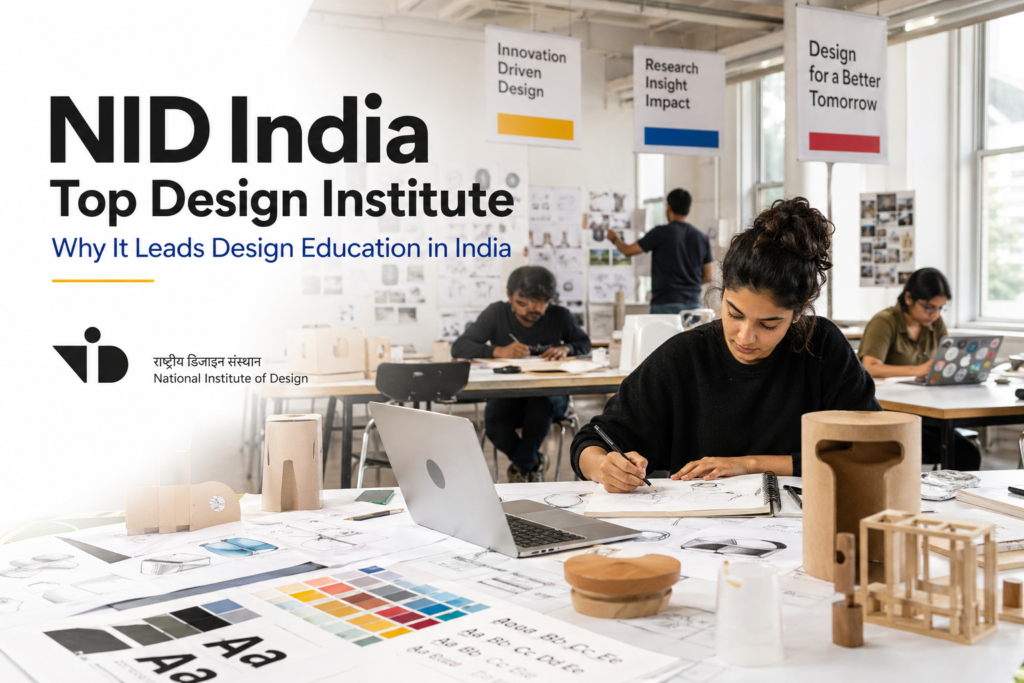
If you have ever asked someone – “Which is the best design institute in India?” – chances are the first name that came up was NID India. As the NID India top design institute’s reputation continues to grow globally, it is easy to see why the National Institute of Design, commonly known as NID, has been a symbol of design excellence in India for over six decades. Whether you are a student exploring NID B.Des program options, a parent wondering about your child’s future, or a working professional considering the NID M.Des program, this blog answers every question you might have—and explains exactly why NID India top design institute is not just a phrase but a well-earned reality.
For students in central India, especially those searching for NID coaching in Bhopal, NID coaching in Indore, or NID DAT preparation guidance, understanding what makes NID special is the first step toward planning your career.
Did You Know? NID Ahmedabad was established in 1961 on the recommendations of the legendary Charles and Ray Eames – the same American designers whose Eames Chair is an icon of modern furniture design. Their landmark report, known as the “India Report”, laid the philosophical foundation for design education in India.
1. History and Legacy: Where It All Began
The history of NID India goes back to 1961 when the Government of India established NID Ahmedabad as an autonomous institution under the Ministry of Commerce and Industry. The NID Ahmedabad founding year marks a turning point for design education in Asia. Unlike engineering or medicine, design was not yet recognised as a serious profession in India at that time – NID changed that narrative completely.
Over the decades, NID evolved from a single campus in Ahmedabad to a network of NIDs across India. Today, if you ask how many NIDs are there in India, the answer is 25 National Institutes of Design – spread across states including Andhra Pradesh, Assam, Haryana, Jorhat, Amaravati, and many more – with the original NID Ahmedabad continuing to serve as the flagship institution.
This NID legacy and heritage is not just about age – it is about decades of producing world-class designers who have shaped brands, products, spaces, and policies across India and internationally.
NID Campuses Across India (Snapshot)
| Campus | State | Established |
| NID Ahmedabad (HQ) | Gujarat | 1961 |
| NID Gandhinagar | Gujarat | 2008 |
| NID Bengaluru | Karnataka | 2006 |
| NID Amaravati | Andhra Pradesh | 2014 |
| NID Jorhat | Assam | 2013 |
| NID Kurukshetra | Haryana | 2014 |
Also Read :- Is NID Only for Good Drawing Students? The Truth Every Aspirant Must Know
2. Is NID a Government Institute? Accreditation and Status
One of the most common questions is: “Is NID a government institute?” Yes – NID is a government institute under the Ministry of Commerce and Industry, Government of India. It holds the status of an NID autonomous status institution, which means it has the freedom to design its own curriculum, conduct its own entrance examinations, and award its own degrees – without being affiliated to any university.
Regarding NID accreditation: NID is recognised by the All India Council for Technical Education (AICTE) and holds a strong academic reputation comparable to IITs and IIMs in their respective fields. For students asking “NID affiliated to which university?” – NID is not affiliated to any university; it is fully autonomous, which is actually a mark of prestige.
Feature Snippet: NID India is a government autonomous institution under the Ministry of Commerce and Industry. It is recognised by AICTE and is among the few design institutes in India empowered to award its own degrees independently.
3. NID Course Offerings: From B.Des to PhD
One major reason why NID India top design institute status is unchallenged is its comprehensive range of NID design programs. Whether you are fresh out of Class 12 or a working professional looking to upskill, NID has a programme for you.
Programmes Offered at NID
- NID B.Des program (Bachelor of Design) – 4-year undergraduate programme open to Class 12 pass students
- NID M.Des program (Master of Design) – 2.5-year postgraduate programme for graduates from any discipline
- NID PhD program – Research doctorate in design for those pursuing advanced academic or industry research
- Graduate Diploma Programme in Design (GDPD) – Lateral entry option for diploma holders
NID Design Disciplines Offered
- Product Design – One of the most popular; focuses on industrial objects, ergonomics, and manufacturing
- Communication Design – Covers graphic design, typography, visual communication
- Textile Design – Traditional and contemporary fabric and surface design
- Furniture and Interior Design – Space planning, furniture systems, interior experiences
- Film and Video Communication – Motion pictures, documentary, animation storytelling
- Animation Film Design – One of India’s most competitive and sought-after design disciplines
- Strategic Design Management – Business-meets-design discipline; highly relevant for consulting and branding roles
- Interaction Design – UI/UX, digital products, human-computer interaction
- Universal Design – Inclusive design for all users, including people with disabilities
The breadth of NID course offerings is simply unmatched in India. No other institution offers this many design specialisations under a single, government-backed autonomous roof.
Also Read :- How Design Aspirants Helped Students Get AIR Under 100 in NID
4. NID’s Unique Learning Philosophy: Studio-Based Education
What truly sets NID apart is its NID design philosophy. Unlike conventional colleges where students sit in classrooms and listen to lectures, NID follows a NID studio-based learning model. This means students spend most of their time working in NID studios and workshops – hands-on, project-based environments where they create real products, solve real problems, and interact with real industry professionals.
The philosophy is rooted in the Bauhaus tradition – learning by making. This approach is exactly what NID is known for – producing designers who don’t just know design theory but can actually build, prototype, fabricate, and deliver solutions.
State-of-the-Art Facilities at NID
- NID campus facilities include dedicated workshops for woodworking, metalworking, ceramics, and textiles
- Advanced digital fabrication labs with 3D printers, laser cutters, and CNC machines
- Professional photography and film studios
- Well-stocked design libraries with rare international design publications
- Open collaborative studio spaces that encourage interdisciplinary thinking
Did You Know? NID Ahmedabad has one of the finest design libraries in Asia, housing over 80,000 books, journals, and visual resources – many of which are rare international design publications unavailable elsewhere in India.
5. Faculty Profile: Learning from the Best
The NID faculty profile is another defining factor. NID’s faculty includes practising designers, researchers, artists, and industry veterans – not just academic theorists. Many faculty members have worked with top corporations like Tata, Philips, and international design consultancies before joining NID.
Guest lectures and workshops by globally recognised designers are a regular feature. This bridge between academia and practice is what makes the NID design education model unique and highly relevant in 2025.
6. NID Placement Record and Alumni Success
The NID placement record is consistently impressive. Graduates from NID Ahmedabad and other campuses have been placed at top companies including Apple, Samsung, Microsoft, Titan, Mahindra, IDEO, Frog Design, Philips, and many more. NID industry tie-ups with leading corporations ensure that students get real internships and pre-placement opportunities during their studies.
Where NID Alumni Work
Global tech companies: Apple, Google, Microsoft, Samsung
- Indian conglomerates: Tata, Mahindra, Godrej, Titan, Infosys
- Design consultancies: IDEO, Frog Design, Designit
- Own startups and studios: Many NID alumni success stories involve independent studios that have won international design awards
- Film and media: Several NID alumni are award-winning filmmakers and animators
Feature Snippet: NID alumni have founded successful companies and worked at some of the world’s most recognisable brands. The NID alumni network spans 60+ years and thousands of professionals across product design, communication, fashion, and digital experiences.
7. NID vs Other Design Colleges: A Clear Comparison
A common debate among design aspirants is: NID vs NIFT, NID vs CEED, NID vs MIT Institute of Design, or NID vs Srishti School of Art. Let us break it down clearly.
| Parameter | NID | NIFT | MIT-ID | Srishti | Pearl |
| Type | Govt Autonomous | Govt Autonomous | Private | Private | Private |
| Disciplines | 20+ | Fashion-focused | 15+ | Art & Design | 10+ |
| Fees (approx) | ₹2–4 L/year | ₹2–3 L/year | ₹4–8 L/year | ₹4–7 L/year | ₹5–8 L |
| Placement Quality | Excellent | Good | Good | Moderate | Moderate |
| International Recognition | Very High | Moderate | Moderate | Growing | Limited |
| Research (PhD) | Yes | No | No | No | No |
When comparing NID vs private design colleges India, the verdict is clear for most serious design aspirants: NID’s combination of government backing, low fees, exceptional faculty, world-class facilities, and strong alumni network makes it the number one choice.
Even against international benchmarks, NID ranking compared to international design schools shows NID holding its own credibly – especially in industrial and product design.
Also Read:- Who Should Choose NID as a Career Option?
8. NID International Collaborations and Global Recognition
NID does not operate in isolation. NID international collaborations include partnerships with institutions like the Royal College of Art (UK), Domus Academy (Italy), and various European and Asian design schools. These collaborations enable student exchange programmes, joint research projects, and faculty sharing.
This is a major reason NID India recognition globally has grown substantially. Several NID alumni have gone on to complete their advanced studies at top international design schools – a testament to the strength of the NID degree.
For those asking “how NID prepares students for international design careers” – the answer lies in its globally benchmarked curriculum, multilingual design thinking workshops, and exposure to international faculty and projects during the programme.
9. NID Design Research: A Pillar of Innovation
One aspect that truly separates NID from every private design college is NID design research. NID houses multiple research centres focused on areas like traditional craft preservation, inclusive design, urban mobility, sustainability, and digital futures.
The NID PhD program attracts some of the brightest design thinkers in the country, and research outputs from NID have influenced government policy, public sector projects, and global design standards.
Did You Know? NID has played a direct role in designing India’s currency notes, national symbols, and several public sector visual identity systems. Its work goes well beyond academic projects – NID designs impact everyday Indian life.
10. NID Admission: DAT Exam, Eligibility, and Process
The gateway to NID is the NID DAT exam (Design Aptitude Test). Understanding NID selection process explained is crucial for every aspirant.
NID DAT – Key Facts
- NID eligibility criteria: Minimum 10+2 pass for B.Des; graduation for M.Des
- NID which stream students can apply: Any stream – Science, Commerce, Arts – can apply for B.Des
- The DAT consists of two stages: Prelims (written/drawing test) and Studio Test (hands-on)
- NID DAT studio test evaluates creativity, spatial reasoning, observation, and craft ability
- NID acceptance rate is extremely low – typically under 1% for popular disciplines like Product Design
- NID application process is entirely online; check the official NID website each year for dates
For those wondering “how hard is NID entrance exam”: it is among the most competitive entrance tests in India for any creative field. How to crack NID in first attempt requires consistent practice starting at least 12–18 months in advance.
NID DAT Preparation Tips
- Develop a daily drawing and observation habit – NID portfolio tips for beginners always start with sketchbook practice
- Study design history, famous designers, and NID design philosophy
- Practice spatial puzzles, pattern recognition, and creative thinking exercises
- Join a reliable NID DAT preparation coaching centre or online course
- Avoid NID common mistakes like ignoring the Studio Test or over-preparing only for the written paper
- For local students: explore NID coaching in Bhopal or NID coaching in Indore to get structured guidance
Feature Snippet – What Skills Are Needed for NID Admission? NID looks for visual thinking, creativity, observation skills, material sensitivity, and an intuitive understanding of aesthetics. Academic scores matter less than your design sensibility and ability to think spatially and creatively.
11. NID Fees: Affordable Excellence
One of the biggest advantages of choosing NID India top design institute over private alternatives is affordability. NID fees for the B.Des programme typically range between ₹2 to ₹4 lakhs per annum – significantly lower than most private design colleges that charge ₹5–10 lakhs per year.
Additionally, NID offers scholarships and fee concessions based on merit and economic background, making it one of the most accessible world-class design programmes in India. NID hostels are available on campus, which further reduces the cost of living for outstation students.
12. Why Students Choose NID Over All Other Options
When you ask any serious design student “reasons to choose NID over private design colleges”, here is what they consistently say:
- Brand value: The NID name opens doors – internationally and within India – that no private college can match
- Faculty quality: Practising designers and researchers who bring real-world relevance to every classroom
- Peer environment: Being surrounded by the country’s top design talent pushes every student to grow rapidly
- Cost-effectiveness: World-class education at government fees – NID India offers unbeatable ROI
- Research opportunities: Unique access to NID design research labs and industry-linked projects
- Alumni network: A 60-year-old network of top designers willing to mentor juniors
- Placements: Consistent top-tier NID placement record across all disciplines
Also Read:- What Is the Average Salary After NID in India?
13. NID Industry Relevance in 2025
Design is no longer a niche field. In 2025, companies in every sector – from fintech to healthcare, from electric vehicles to sustainable fashion – are actively hiring designers. NID industry relevance in 2025 has never been higher.
NID’s curriculum has kept pace with these changes. New programmes in Interaction Design and Strategic Design Management ensure that graduates are prepared for the digital economy. NID industry tie-ups now include edtech companies, sustainability startups, and government innovation labs – broadening the employment landscape for graduates significantly.
For anyone wondering “is NID worth the effort for design aspirants” – the answer in 2025 is an emphatic yes. The design industry is growing fast, and an NID degree positions you at the very top of that growth curve.
14. Starting Your NID Journey: A Practical Roadmap
If you are in Class 11 and want to know “how to start NID preparation”, or if you are a Class 12 student asking “NID for 12th pass students – what next?”, here is a simple roadmap:
| Stage | What To Do |
| Class 11 | Start a sketchbook habit. Study colour, form, and famous designers. Explore different materials. |
| Class 12 (First Half) | Join structured NID DAT coaching. Solve past papers. Develop your design portfolio. |
| Class 12 (Second Half) | Intensive mock tests. Studio test practice. Register for NID DAT Prelims. |
| After Prelims | Prepare for Studio Test. Revisit hands-on projects. Practice under timed conditions. |
| Post-Result | If selected: join NID. If not: use feedback to prepare stronger for next attempt. |
Students in Madhya Pradesh looking for NID coaching in Bhopal or NID coaching in Indore can find specialised NID DAT classes Bhopal and NID preparation center Indore that offer both classroom and online formats. For those from smaller towns, NID coaching central India options are expanding rapidly, making quality preparation more accessible than ever.
Whether you need NID study material, NID mock test series, a NID crash course, or a full NID foundation course – starting early and staying consistent is the single biggest predictor of success in the NID DAT exam.
Conclusion: NID Is Not Just a College – It’s a Career Launchpad
After examining every dimension – history, accreditation, faculty, facilities, placements, research, fees, and global recognition – it is clear why NID India top design institute is a title that has stood the test of time.
NID is not just the best design institute India has produced – it is a design culture, a philosophy, and a community. From the NID B.Des program to the NID PhD program, from the workshop floor to the boardrooms of global companies, NID continues to shape how India and the world think about design.
If your dream is to be a designer, then your goal should be clear: aim for NID. And if you need help getting there – whether through NID DAT preparation, NIFT entrance exam coaching, UCEED IIT design admission, or CEED M.Des preparation – find the right guidance, start early, and never stop creating.
Design your future. Start your NID journey today.
For NID coaching in Bhopal, Indore & Central India – contact us today.
Frequently Asked Questions (FAQs)
These FAQs are based on real search queries related to this blog. They are optimized for featured snippets, voice search, and Google’s People Also Ask (PAA) section.
Q1. Why is NID considered the best design institute in India?
NID – National Institute of Design – is considered India’s top design institute because of its 60+ year legacy, government autonomous status, studio-based learning model, world-class faculty, 20+ design disciplines, strong NID placement record at global companies, and exceptional NID alumni success stories. No private college in India matches this combination.
Q2. What is the NID DAT exam and who can appear for it?
NID DAT (Design Aptitude Test) is the national entrance exam for NID admission. Students from any stream – Science, Commerce, or Arts – who have passed Class 12 can apply for the NID B.Des program. Graduates from any discipline can appear for the NID M.Des program. The exam tests creativity, visual thinking, and spatial reasoning.
Q3. How many NIDs are there in India and which is the best campus?
There are 25 National Institutes of Design across India. NID Ahmedabad is widely regarded as the best NID campus due to its founding status (1961), flagship programmes, superior faculty, industry connections, and the strongest NID alumni network. It is the original institution and remains the benchmark for all others.
Q4. Is NID better than NIFT or private design colleges for a design career?
For most design disciplines, NID is considered stronger than NIFT and significantly ahead of private institutes like Srishti or Pearl Academy. NID fees are lower (₹2–4 L/year vs ₹5–8 L at private colleges), placements are better, and NID international recognition is far higher. NIFT has an edge specifically in fashion and textile design.
Q5. What is the fee structure of NID and does it offer hostel facilities?
NID fees for the B.Des programme range from approximately ₹2 to ₹4 lakhs per annum – considerably lower than most private design institutes. NID also offers merit-based scholarships and economic concessions. Yes, NID hostel facility is available on campus, making it affordable even for outstation students.
Q6. How should I start NID DAT preparation if I am in Class 11 or 12?
Start by building a daily sketching habit and studying design history. Join structured NID DAT preparation coaching – whether at a NID coaching in Bhopal, NID coaching in Indore, or online. Practice past papers, develop your portfolio, and focus equally on the NID DAT Studio Test. Beginning 12–18 months before the exam significantly improves your chances.