
UCEED 2027 marks vs rank cannot be fixed in advance because the rank produced by a particular score can change with paper difficulty and overall candidate performance. For IIT B.Des admission, your final All India Rank, category, institute preference and seat availability matter more than marks alone. Previous-year trends can help you set a target, but they should never be treated as a guaranteed prediction.
If you’re preparing for UCEED 2027, you’ve probably finished a mock test, looked at your score and wondered, “Is this enough for IIT Bombay?” That’s a fair question. Your score tells you how you performed in one paper, but what you’re really trying to understand is where that performance could place you among thousands of other aspirants.
This is where students often mix up three different things: marks, rank and admission. A strong score doesn’t automatically produce the same rank every year, and even a competitive rank has to be viewed alongside your category, institute preferences and the seats available during counselling.
If you’re still unclear about how the examination itself is divided, first understand how UCEED Part A and Part B work together. Once the paper structure is clear, marks-versus-rank becomes much easier to understand.
There is no official UCEED 2027 marks-vs-rank chart yet. Your final score first has to translate into an All India Rank, and that rank is then considered during the B.Des admission process. Previous-year trends are useful for measuring how competitive a score may be, but they should be used as preparation benchmarks rather than guaranteed 2027 outcomes.
Why UCEED 2027 Marks vs Rank Cannot Be Predicted Exactly
Let’s take a simple example. Imagine two students scoring 185 marks, but in two different UCEED years. In the first year, the paper is difficult and relatively few students cross 185. In another year, the paper is easier and a much larger group performs in that range.
The score is the same, but the student’s position in the competition may be completely different. That’s why statements such as “185 marks always means AIR X” should be treated carefully unless they clearly mention which year’s data they are using.
Previous-year numbers still have value. They show you how competitive certain scores have been and can help you understand the level of preparation required. They simply can’t promise the same result for UCEED 2027.
Did You Know?
UCEED requires students to balance different kinds of abilities rather than depend on one strength alone. That is why focusing only on drawing or only on aptitude can create an imbalance in your overall preparation.
If your scores keep falling because of poor question selection, inconsistent section performance or avoidable errors, it is worth checking the most common mistakes students make during UCEED preparation before simply attempting another mock.
What Is a Good Score in UCEED 2027?
There is no officially declared “good score” for UCEED 2027 yet. That doesn’t make mock scores meaningless. In fact, mocks are one of the most useful ways to understand whether your preparation is moving in the right direction—as long as you look beyond the number written at the top of the paper.
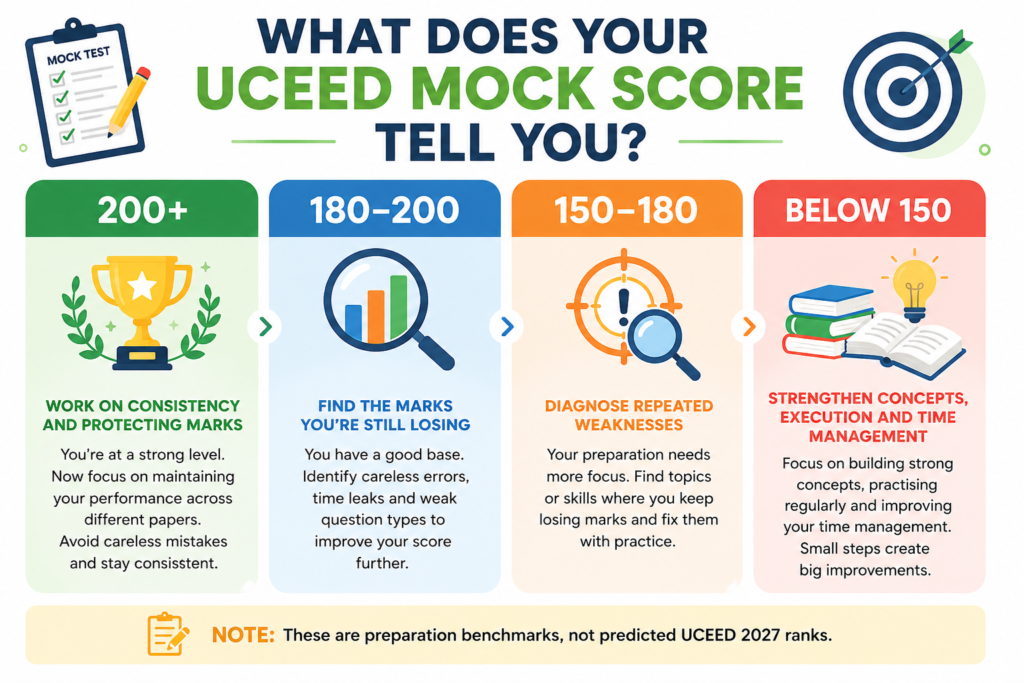
The ranges below should therefore be treated as preparation benchmarks, not as official UCEED 2027 cutoffs or guaranteed ranks.
If You’re Crossing 200 in Mocks
Crossing 200 in a realistic full-length mock is encouraging, but one strong paper isn’t enough to judge your preparation. Look at your last four or five attempts together.
For example, 203 → 198 → 207 → 194 → 201 tells a very different story from 205 → 158 → 173 → 161 → 199. The first pattern suggests consistency. The second tells you that the ability is there, but your performance still changes too much from one paper to another.
At this stage, you may gain more by protecting marks than by trying to learn dozens of new things. Work on accuracy, question selection, time control and maintaining steady performance across the paper.
If You’re Around 180–200
This is where students often start searching for college predictions too early. Instead of immediately asking, “Which IIT will I get?”, ask a more useful question: where are the next 15 marks?
Perhaps the concept is clear but you’re rushing. Maybe certain question types take too long. You might understand a Part B problem well but struggle to communicate the idea clearly enough.
If reasoning-based questions are one of the areas pulling your score down, work specifically on improving logical reasoning for UCEED instead of trying to improve everything at once.
Your mocks should also become analysis tools rather than scorecards. The guide on using mock tests effectively during UCEED preparation can help you build a better review routine after every paper.
If You’re Around 150–180
This is where rank prediction can become a distraction. Suppose you score 164. Instead of opening ten websites searching for “UCEED rank at 164 marks,” go back to the paper and ask why that 164 wasn’t 180.
Did you lose marks because you didn’t know the concept? Did you understand the question but make a careless error? Or could you have answered correctly if you had managed your time better?
If 8 marks disappear through avoidable mistakes and another 12 through poor time allocation, your score has already given you something much more valuable than a predicted rank: a clear improvement plan.
If you keep facing similar problems across different mocks, the article on common UCEED preparation challenges and how to overcome them can help you identify whether the problem is conceptual, strategic or related to consistency.
If You’re Below 150
Don’t treat a lower mock score like a final UCEED result. It tells you that there are gaps to work on; it doesn’t tell you that your target is out of reach.
Your weak areas could be visualisation, observation, logical reasoning, drawing, time management or simply an ineffective attempt strategy. The goal now is to identify those gaps before worrying about the rank.
You can use the UCEED study material and practice resources available on Design Aspirants to check whether the same weaknesses appear across different kinds of questions.
Design Aspirants Mentor Note
Don’t judge your preparation by the highest score you’ve ever received. Look at your recent score range. If that range is gradually improving and the same mistakes are appearing less often, you’re moving in the right direction.
What Rank Was Needed for IIT B.Des in 2026?
Once you move beyond mock-test scores, actual admission ranks become much more useful than unofficial predictions.
For Round I of the 2026–27 B.Des admission process, the official OPEN-category All India Rank ranges were:
| Institute | 2026 Round-I OPEN AIR |
| IIT Bombay | 1–14 |
| IIT Delhi | 17–28 |
| IIT Guwahati | 15–77 |
| IIT Hyderabad | 19–40 |
| IIT Indore | 42–66 |
| IIT Roorkee | 59–90 |
| IIITDM Jabalpur | 91–142 |
Important: These are historical Round-I OPEN-category admission ranks from 2026. They should not be presented as UCEED 2027 predictions. Reserved-category ranks also need to be read within their own category context rather than compared directly with OPEN AIR.
To understand why even a relatively small movement in rank can change admission possibilities, explore the UCEED selection ratio, seats and competition analysis.
Did You Know?
IIT Bombay’s OPEN closing AIR in Round I of the 2026 B.Des admission process was 14. That does not mean AIR 14 will remain the same cutoff in 2027; it shows how competitive IIT Bombay was during that particular admission cycle.
How Many Marks Do You Need for IIT Bombay Through UCEED?
There is no fixed number of marks that guarantees IIT Bombay B.Des admission. That’s the most important thing to understand.
According to the official UCEED 2026 Round I seat allotment data, IIT Bombay’s OPEN seats had an opening AIR of 1 and a closing AIR of 14. However, the marks needed to reach a similar rank can change from year to year depending on factors such as:
- Paper difficulty
- Overall candidate performance
- Score distribution
- Competition for available seats
So, if IIT Bombay is your goal, don’t build your entire preparation around one question: “What’s the minimum score I need?”
Ask instead: “How can I make my final rank as competitive as possible?”
A better target is to build enough consistency that you can handle a tougher paper, one unexpectedly weak section or a few avoidable mistakes without your overall performance dropping sharply.pectedly weak section or a few avoidable mistakes without your overall performance dropping sharply.
Is 200 Marks Enough for IIT Through UCEED?
A 200-mark mock score can be a strong preparation signal, but it is not a guaranteed IIT score for UCEED 2027. Your actual exam marks first have to translate into an All India Rank (AIR).
After that, your admission possibilities depend on:
- Your final AIR
- Your category
- Institute preferences
- Available B.Des seats
- The relevant seat-allotment round
If you’re regularly scoring around 200, don’t just think, “Now I need 210.” First check the quality of that 200.
Quick Check: Is Your 200 Actually Stable?
Ask yourself:
- Am I consistently scoring near 200 across several mocks?
- Does my score fall sharply when the paper becomes harder?
- Am I repeating the same mistakes?
- Is one section carrying most of my total score?
- Am I losing marks because of accuracy or time management?
These questions tell you far more about your exam readiness than one impressive mock score.
Students who want to strengthen both understanding and application can also read about combining concept-building with practice for UCEED.
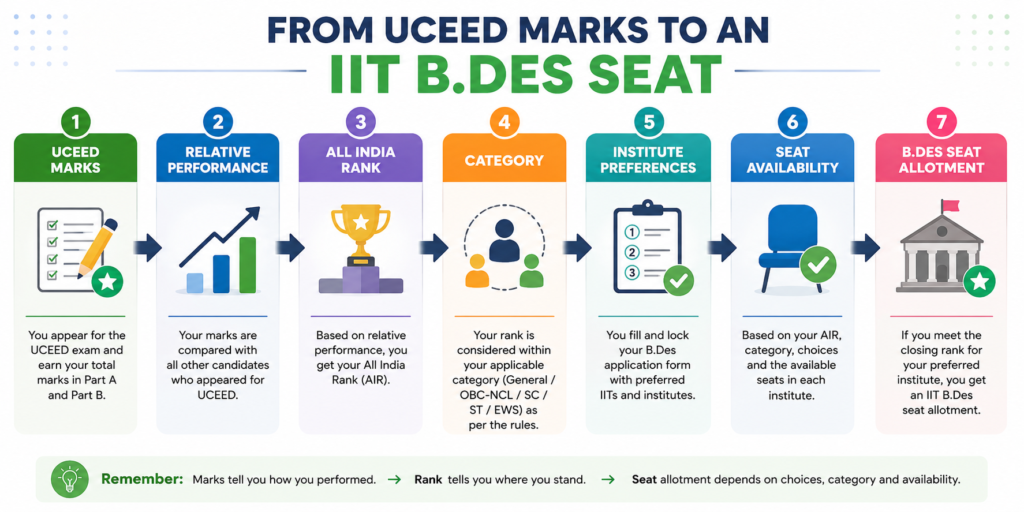
Marks, Rank and Admission Are Three Different Stages
Students often use marks, rank and admission as though they mean the same thing. They don’t.
- Marks: How you performed in the UCEED examination.
- Rank: Where that performance places you among other candidates.
- Admission: What your rank may lead to after category, preferences and seat availability are considered.
Marks → Rank → B.Des Application → Institute Preferences → Seat Allotment
Quick Check
If somebody tells you, “Score exactly 190 and you’ll definitely get IIT X,” don’t immediately plan around that number.
Before trusting such a claim, check:
- Which UCEED year is the figure based on?
- Which category does it refer to?
- Which counselling or allotment round?
- Is the information based on an official source?
- Is it historical data or simply a prediction?
If these details aren’t clear, treat the number as an estimate—not an admission guarantee.
Student Scenario: Your Mock Score Is 165
Suppose your last four mock scores look like this:
157 → 164 → 170 → 166
At first glance, it may feel like your score isn’t improving enough. But the numbers alone don’t tell the whole story.
After reviewing your papers, you discover:
- Around 10 marks are repeatedly lost through rushed answers.
- Visualisation questions are consuming too much time.
- Your Part B concepts are reasonably clear.
- Perspective and presentation are making some answers difficult to communicate effectively.
Now, “I need to somehow reach 200” is no longer a useful preparation plan.
Your next target becomes much clearer:
Reduce careless errors → improve visualisation → practise perspective → strengthen Part B feedback
That gives you specific problems to work on instead of chasing a random score.
If perspective is one of the areas holding your Part B performance back, use the perspective drawing guide for UCEED aspirants as a focused practice resource.
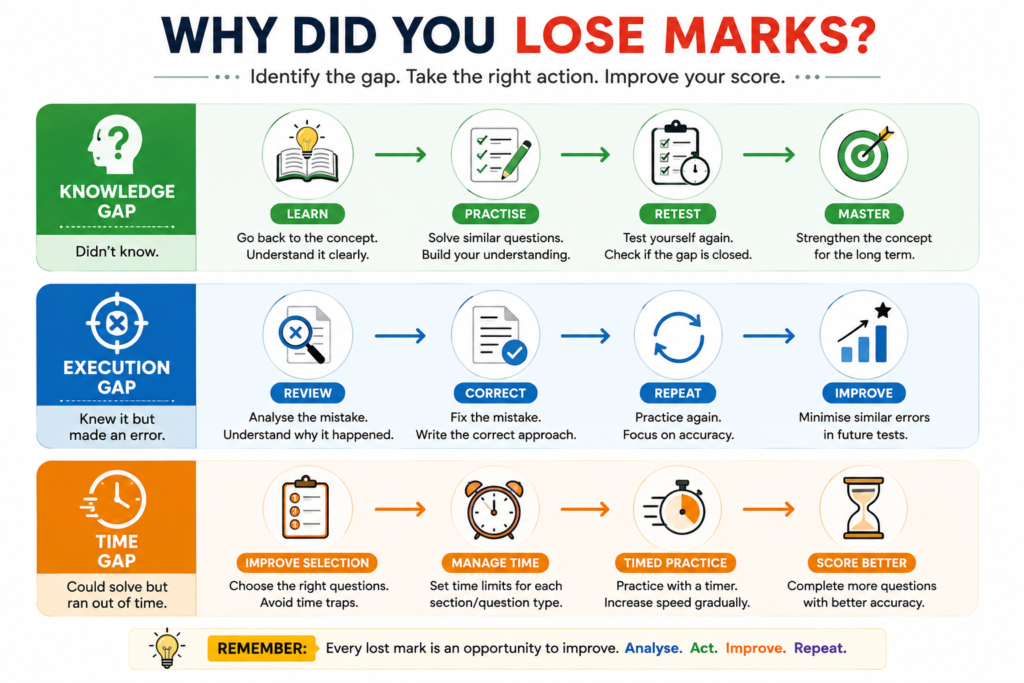
The 3-Gap Method for Analysing a UCEED Mock
1. Knowledge Gap
You didn’t know how to solve the question or didn’t understand the required concept properly. Instead of simply attempting the same question again, return to the concept, practise a few related problems and then retest yourself.
2. Execution Gap
You knew what to do but still lost marks. Maybe you rushed, misread something, marked the wrong option or failed to communicate the final idea clearly. These are often some of the easiest marks to recover because the underlying understanding is already there.
3. Time Gap
You could solve the question, but you never got enough time to complete it. This usually points to a problem with speed, question selection or your overall attempt strategy.
Did You Know?
Taking more mock tests doesn’t automatically mean better preparation. A mock becomes valuable when reviewing it changes the way you approach the next paper.
If you’re unsure how often you should practise or what to analyse afterwards, read the guide on building a smarter UCEED mock-test strategy.
Choosing the Right Practice Material Matters Too
Sometimes a student’s score isn’t stuck because they aren’t studying enough. They’re simply practising from material that doesn’t match the level or style of the examination.
Your resources should expose you to visual reasoning, observation, spatial understanding, problem-solving and creative questions rather than only repetitive aptitude exercises.
If you have too many books, PDFs and online resources and aren’t sure what to prioritise, use this guide on choosing suitable study material for UCEED preparation before adding more resources to your schedule.
Don’t Ignore Part B While Chasing a Target Score
Marks-versus-rank searches naturally make students focus heavily on numbers, but UCEED preparation cannot become only a marks game.
Part A and Part B require different types of thinking. Analytical ability, observation, visualisation and creative communication all matter. If Part B is weak, don’t spend hours merely trying to make drawings look prettier. Ask whether the drawing communicates the idea, proportion, spatial relationship and solution clearly.
Revisit the Part A and Part B preparation approach whenever you feel that one side of your preparation is beginning to dominate the other.
Use Previous-Year Papers to Test Your Preparation
Mocks tell you how you’re performing under a designed practice environment. Previous-year UCEED papers show you what the actual examination has asked.
Use them to identify recurring skill areas, understand how questions are framed and check whether your preparation is becoming too dependent on familiar coaching-style questions.
If you haven’t built previous papers into your study plan yet, the UCEED past-paper practice guide can help you use them more systematically rather than simply solving papers once and moving on.
Where Do You Stand Right Now?
After your next mock, don’t ask only, “Is this score good?” Ask whether your five-mock average is improving, which mistakes keep repeating, whether time pressure is reducing your accuracy and whether your Part B performance is improving along with Part A.
Also check whether you actually review mistakes before attempting another paper. If the answer is no, another predicted rank may not be what your preparation needs right now.
Preparing for UCEED 2027? Turn Your Score Into an Action Plan
Once you understand your score, the next step should be fixing the weaknesses behind it. For students who want a broader roadmap rather than working on one isolated skill, this complete UCEED preparation guide covers study material, structured preparation and different ways of building an exam plan.
If you’re also planning your preparation around the exam cycle, keep the UCEED 2027 exam date and registration guide handy so that preparation milestones match the actual admission timeline.
Frequently Asked Questions About UCEED 2027 Marks vs Rank
What is a good score in UCEED 2027?
There is no officially declared good score for UCEED 2027 yet. During preparation, use your mock scores to judge consistency and improvement rather than treating any particular number as a guaranteed cutoff. The true value of your examination score becomes clearer when it translates into an All India Rank.
Is 200 marks a good score in UCEED?
A score around 200 can be considered a strong preparation benchmark when you’re achieving it consistently in realistic full-length mocks. However, the actual AIR associated with 200 marks can change between exam years, so it should not be treated as a fixed IIT admission score.
What rank is required for IIT Bombay through UCEED?
In the 2026 Round-I B.Des admission process, IIT Bombay’s OPEN seats had an opening AIR of 1 and a closing AIR of 14. These are historical figures and should be used for understanding competition rather than treated as guaranteed UCEED 2027 cutoffs.
How many marks are required for IIT Bombay B.Des?
There is no permanent marks figure that guarantees IIT Bombay admission. Marks first translate into an All India Rank, and that marks-to-rank relationship can change each year. Your final AIR is therefore more useful for admission planning than a pre-exam marks prediction.
Is qualifying UCEED enough for IIT admission?
No. Qualifying UCEED and receiving an IIT B.Des seat are different stages. Admission depends on the applicable eligibility requirements, rank, reservation category, institute preferences and available seats during the counselling process.
Can I predict my UCEED 2027 AIR from mock scores?
Not accurately. Mock scores are useful for tracking your preparation, but mock difficulty, actual exam difficulty and candidate performance can all differ. Treat mock scores as progress indicators rather than exact rank predictors.
Should I focus on marks or rank during UCEED preparation?
During preparation, focus on the things you can control: marks, accuracy, time management, problem-solving and consistency. Once the actual UCEED result is declared, your AIR becomes much more useful for comparing B.Des admission possibilities.
How should I improve if my UCEED mock score is not increasing?
Start by identifying whether the lost marks come from a knowledge gap, execution error or time-management problem. Track these patterns across multiple mocks instead of judging yourself from a single test. Once the recurring issue becomes clear, direct your next practice cycle towards that specific weakness.
Final Takeaway
Understanding UCEED 2027 marks vs rank is useful when it helps you set a realistic preparation target. It becomes less useful when an unofficial predicted rank begins controlling every preparation decision.
If you’re around 150, look for the next recoverable 15 marks. If you’re around 180, identify what’s preventing you from reaching 200. If you’re already crossing 200, work on making that performance repeatable across papers of different difficulty levels.
You can’t control how every other UCEED candidate performs. You can control how well prepared you are when the actual paper arrives.
Ready to Strengthen Your UCEED 2027 Preparation?
If your score analysis has shown you where the gaps are, the next step is to work on them systematically. Students looking for structured guidance across Part A, Part B, practice and mock analysis can explore the IIT UCEED preparation programme at Design Aspirants.
Know your score. Understand why you’re losing marks. Then work on the marks you can still gain.