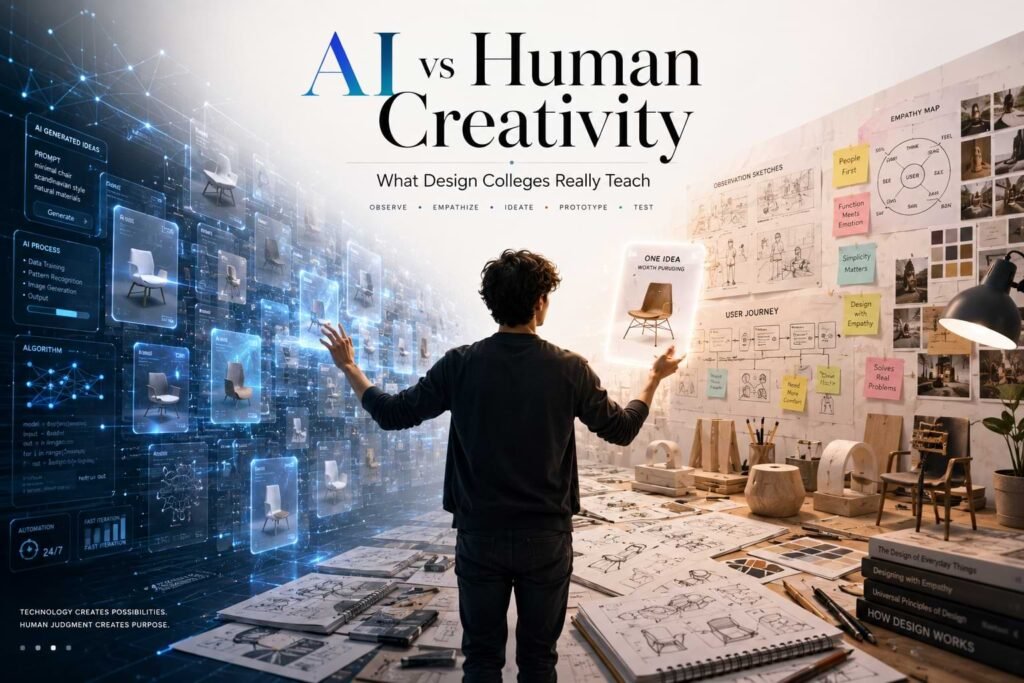
AI vs Human Creativity is not really a competition – it is a partnership, and design colleges are built to protect the human half of that equation. AI tools generate visuals, layouts, and concepts in seconds, but they cannot observe a real problem, feel empathy for a user, or decide which idea genuinely deserves to exist. That single distinction explains why design education has not become outdated and why entrance exams for NID preparation, NIFT preparation, UCEED preparation, and CEED preparation still test human thinking far more than software skills.
This blog breaks down exactly what design colleges teach, how AI fits into modern design work, and why human creativity remains the deciding factor in every meaningful design. Understanding AI vs Human Creativity early on helps aspiring designers prepare for the industry with confidence instead of confusion.
What Does AI vs Human Creativity Actually Mean?
The phrase AI vs Human Creativity describes the growing conversation around whether machines can replace the creative judgment of human designers. AI systems like ChatGPT, Midjourney, Adobe Firefly, Canva AI, and Figma AI can produce logos, layouts, and product concepts almost instantly. But generating an image is not the same as solving a real design problem.
AI recognises patterns from existing data and predicts what an output should look like. It does not experience emotion, understand cultural context, or independently notice a problem worth solving. Human creativity, on the other hand, starts with observation – noticing that a child struggles to open a bottle cap, or that elderly patients get lost in a hospital corridor – and only then moves toward a solution.
How AI Is Changing Design Work
AI has undeniably sped up repetitive design tasks. Instead of spending hours on layout variations or mood boards, designers can now generate several options within minutes. Commonly used tools include ChatGPT, Midjourney, Adobe Firefly, Canva AI, Figma AI, Runway, Gemini, and Ideogram.
This shift is exactly where AI for designers becomes relevant – it is a productivity layer that removes repetitive work so designers can focus on strategy, research, and original thinking. Used well, AI for designers speeds up brainstorming and prototyping without replacing the human decisions behind them.
The debate around AI vs Human Creativity often gets reduced to “who wins,” but the more accurate framing is division of labour: AI accelerates execution, while humans remain responsible for defining purpose, interpreting emotion, and making the final call.
What Design Colleges Actually Teach
Contrary to popular belief, design colleges spend relatively little time teaching software. Programs like Photoshop, Illustrator, Figma, or CAD tools change every few years, but the following skills stay valuable throughout a designer’s career:
- Design thinking – the five-stage process of Empathize, Define, Ideate, Prototype, and Test, used by companies like Google, Apple, IDEO, and Airbnb.
- Observation skills – training students to notice confusing signage, poor lighting, or crowd behaviour that most people simply walk past.
- User research – interviews, surveys, shadowing, and journey mapping to design for real people instead of personal assumptions.
- Sketching – a thinking tool used to explore ideas quickly, not a race to produce polished artwork.
- Model making – building paper, foam, or 3D-printed prototypes to test proportions and ergonomics physically.
- Storytelling – connecting a product to the emotions and journey of the person using it.
- Systems thinking – understanding how a single product fits into a larger ecosystem of infrastructure, cost, and behaviour.
- Ethics and responsible design – accessibility, sustainability, privacy, and cultural sensitivity, which no algorithm can judge on its own.
This is the real foundation behind AI vs Human Creativity colleges are not competing with software, they are training the judgment that decides how software should be used.
Also Read – Will AI Replace Designers?
Human Creativity vs Artificial Intelligence: A Side-by-Side Comparison
| Human Creativity | Artificial Intelligence |
| Identifies real-world problems | Responds to prompts |
| Conducts user research and interviews | Generates outputs from existing data |
| Understands emotions and context | Recognises statistical patterns |
| Makes ethical, value-based decisions | Follows programmed logic |
| Creates original experiences | Recombines existing information |
| Builds empathy through interaction | Processes datasets |
| Thinks strategically over time | Optimises for a given instruction |
A simple way to remember the difference in AI vs Human Creativity AI answers questions, but designers are trained to discover which questions are worth asking in the first place.
Why NID, NIFT, UCEED, and CEED Still Test Human Thinking
If software could replace human creativity, India’s design entrance exams would already look completely different. Instead, they continue to prioritise observation, logical reasoning, and original ideas over image generation.
Also Read – How AI Is Changing the Future of Design Careers: What Designers Need to Know
| Exam | What It Primarily Evaluates |
| NID preparation | Observation, storytelling, visual imagination, design thinking |
| NIFT preparation | User understanding, materials, aesthetics, functional creativity |
| UCEED preparation | Visualisation, spatial reasoning, analytical and creative thinking together |
| CEED preparation | Critical thinking, design sensitivity, advanced problem analysis |
Students preparing through these design exams are consistently tested on how they think and observe – not on which AI tool they can operate. This is another practical proof point in the larger AI vs Human Creativity conversation: examiners are deliberately measuring the parts of creativity that software cannot fake.
Skills That AI Still Cannot Replace
| Skill | AI Capability | Human Capability |
| Empathy | Limited | Strong |
| Critical thinking | Limited | Strong |
| Observation | Pattern-based | Experience-based |
| Ethical judgment | Cannot decide values | Essential and ongoing |
| Leadership | Cannot manage people | Inspires and coordinates teams |
| Innovation | Recombines existing ideas | Creates original concepts |
How Students Can Strengthen Human Creativity
- Observe everyday situations – bus stops, school bags, packaging, and public spaces – for problems worth solving.
- Sketch daily to build visualisation and communication skills, not artistic perfection.
- Read outside design – psychology, sociology, and business – to broaden perspective.
- Build physical models to understand proportion and material behaviour first-hand.
- Ask “why” repeatedly instead of accepting existing solutions.
- Share work for feedback and treat criticism as part of the design process.
Did You Know? Building even simple cardboard or clay prototypes reveals design flaws that are often invisible in digital sketches or AI-generated renders.
Together, these habits show that AI vs Human Creativity is ultimately decided by how consistently a student practises observation, empathy, and problem-solving – not by which AI tool they can access.
Frequently Asked Questions
Can AI replace designers completely?
No. AI can automate repetitive tasks and generate concepts quickly, but it cannot replace empathy, ethical judgment, or human-centered problem-solving.
Will design colleges continue to be relevant?
Yes. Colleges build long-term thinking skills – observation, research, and design thinking – that stay valuable regardless of which software trends come and go.
Do designers need AI?
Yes, in a supporting role. It speeds up brainstorming and research, but final creative decisions still rest with the designer.
Is sketching still important in the AI era?
Yes. Sketching remains a thinking process used to explore ideas, spot flaws early, and communicate concepts, which AI-generated images cannot substitute.
Should I learn AI before joining design college?
Basic familiarity is useful, but design fundamentals such as observation, sketching, and design thinking should come first, with AI added as a productivity tool afterward.
Final Thoughts
AI has changed how design work gets done, but it has not changed why design exists. Every meaningful product still begins with a human noticing a problem, feeling empathy for the people affected by it, and deciding which solution is worth building. That is the real answer to the AI vs Human Creativity debate – not competition, but collaboration, with humans firmly in charge of purpose and judgment.
Whether you are preparing through NID preparation, NIFT preparation, UCEED preparation, or CEED preparation, focus on the qualities no machine can replicate: curiosity, observation, empathy, and original thinking. These are exactly what design colleges are built to teach, and exactly what will keep human designers essential long after AI vs Human Creativity stops being a debate at all.