
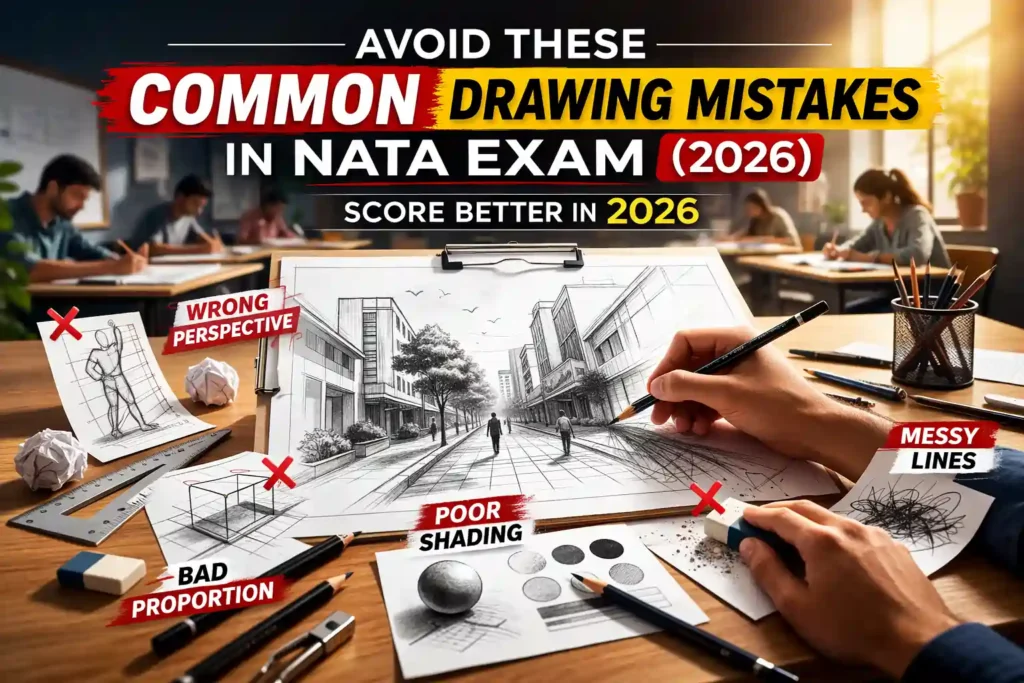
Every year many students prepare seriously for architecture entrance exams but still get low marks in the drawing section. They practice a lot, watch tutorials, and copy sketches – yet the score doesn’t improve. The reason is simple: the problem is not lack of creativity, but repeated technical errors. Understanding the common drawing mistakes in NATA exam is often more important than drawing more pages. When you remove mistakes, your marks automatically increase.
How NATA Drawing Section is Evaluated in 2026
Before improving, you must understand how the examiner checks your sheet. The drawing paper is not judged like an art competition – it is judged like a design aptitude test.
| Evaluation Factor | What Examiner Looks For | Marks Impact |
| Creativity | Unique idea, story, thinking | High |
| Perspective | Depth & 3D understanding | Very High |
| Proportion | Human/object size accuracy | Very High |
| Composition | Balance & spacing | Medium |
| Shading | Light direction & neatness | Medium |
| Observation Skills | Realistic understanding | High |
Important: A simple, clean drawing with correct basics will always score higher than a fancy drawing with wrong fundamentals.
Most Common Drawing Mistakes Students Make in B.Arch Entrance Exams
Below are the mistakes that reduce marks the most. Fixing these alone can increase your score by 15-20 marks.
Wrong Perspective Drawing
Many students draw buildings like rectangles standing straight. Roads don’t narrow, windows don’t align, and objects look pasted on the page.
What happens:
Because of this, the drawing loses depth. The examiner immediately understands the student does not understand space.
Fix:
Always draw using a horizon line and vanishing point. Even a simple road scene should show depth.
Human Figure Proportion Errors
Humans are the easiest way to show scale, but also where students lose marks. Very big heads, tiny legs, or uneven arms make the drawing look childish.
Why this matters:
Architecture requires spatial understanding. Wrong body proportion shows weak observation skill.
Simple trick:
Human height ≈ 7 heads tall
Remember this in every drawing.
Poor Line Quality & Messy Sketch
Some students keep correcting lines again and again. The result becomes dark, scratched, and confusing.
Examiner thinks:
Student lacks confidence → marks reduced. Messy drawings show hesitation. Examiners assume the student is unsure about the form.
Fix habit:
- Draw light first
- Final dark lines later
- Don’t over-erase
Wrong Light & Shadow Direction
Shadow going left while sun is drawn on the right – very common error. This is one of the biggest B.Arch Drawing Mistakes because it breaks realism instantly.
Rule: One light source → one shadow direction
The drawing may look nice but it stops making sense visually. Decide on the light source before shading and follow it everywhere.
Flat Drawings Without Depth
No overlap, no scaling, no foreground/background.
Result:
Looks like a poster instead of a space.
Add depth using:
- Near objects bigger
- Far objects smaller
- Overlapping elements
Ignoring Background & Environment
Students often draw the main object perfectly and leave the rest blank. Empty space makes drawing incomplete.
Problem: Composition incomplete → marks cut
Add small elements:
- Trees
- People
- Sky
- Ground texture
Overcrowded Composition
Some students try to show creativity by filling every space. Instead of interesting, the drawing becomes confusing.
Good drawing ≠ filling every inch
Good drawing = balance
The eye should know where to look first. Space around the subject is important.
Lack of Creativity / Copy-Like Drawing
Drawing memorized scenes such as park or house repeatedly reduces marks because it does not answer the question specifically.
The drawing must respond to the situation asked in the paper.
Poor Time Management During Drawing Test
Students spend too long perfecting one area and cannot finish the paper. This is one of the biggest common drawing mistakes in NATA exam because incomplete work loses marks even if quality is good.
Why Students Lose Marks Even If Drawing Looks Good
Many students say:
“My drawing looked nice but still I got low marks”
Because examiners don’t judge beauty – they judge design thinking.
Typical reasons:
- The idea does not matching the question.
- No story in drawing
- Objects floating without ground
- No human interaction
Your drawing must communicate a situation, not just show objects.
For example, a beautiful street drawing will score less if the question asked for a rainy day and you did not show rain effect.
Real Examples of Mark Deduction in NATA Drawing (2026 Pattern)
| Situation | Student Thinks | Examiner Thinks | Result |
| Beautiful shading but wrong perspective | Looks realistic | Spatial understanding weak | Marks cut |
| Creative concept but messy | Good idea | Poor presentation | Marks cut |
| Clean drawing but empty | Neat work | No thinking | Low score |
This is why understanding common drawing mistakes in NATA exam is more important than practicing random sketches.
How to Fix These Drawing Mistakes (Practical Improvement Plan)
Daily 20-Minute Sketch Routine
Do every day:
- 5 min objects
- 5 min human poses
- 5 min perspective street
- 5 min shading
Consistency matters more than talent. Instead of drawing long, complicated scenes, practice short exercises daily. Regular observation training builds confidence quickly.
Perspective Practice Method
Draw only boxes for 7 days. Practice drawing simple boxes from different angles. All buildings are combinations of boxes. Once boxes improve, structures improve automatically.
Boxes teach:
- angles
- depth
- alignment
After that, buildings become easy.
Shading Practice Technique
Practice only 3 tones:
- Light
- Medium
- Dark
No need for artistic shading – only clarity.
Composition Improvement Trick
Before drawing, spend 30 seconds planning:
- Where is main subject?
- Where is empty space?
This removes half of B.Arch Sketching Mistakes.
Speed Improvement Strategy
Use timer practice:
- 30 minute full drawing daily
- No erasing allowed
You’ll automatically improve confidence.
What Toppers Do Differently in B.Arch Drawing Exams
Toppers are not artists. They follow a process.
They:
- Plan before drawing
- Keep drawings simple
- Focus on story
- Avoid over-detailing
- Finish paper on time
Most importantly, they avoid the common drawing mistakes in NATA exam rather than trying to make perfect art. They keep drawings simple, readable, and complete.
Quick Checklist Before Submitting Drawing Paper
Check these in last 60 seconds:
- Light source same everywhere
- Human proportions correct
- No floating objects
- Background added
- Perspective aligned
- Clean outlines
- Question requirement fulfilled
This single habit can increase marks significantly.
Final Tips to Score 40+ in NATA Drawing Section
- Clarity beats creativity
- Planning beats speed
- Accuracy beats beauty
- Story beats decoration
Remember: Examiner checks thinking, not talent.
FAQ (High Student Queries)
1. I am bad at drawing, can I still crack NATA?
Yes. NATA checks observation and logic, not artistic talent. Practice basics daily and you can score well.
2. How much drawing skill is required for B.Arch?
Basic freehand sketching is enough. Perspective and proportion matter more than artistic shading.
3. How can I improve drawing fast for NATA?
Practice timed sketches daily and focus on mistakes instead of making pretty drawings.
4. Do examiners expect realistic drawing?
No. They expect understandable drawing with correct concept.
5. Why do I always run out of time in drawing exam?
Because of over-detailing. Keep drawing simple and clear.
Conclusion
Most students don’t fail because of creativity – they fail because of repeated errors. Once you understand the common drawing mistakes in NATA exam, your preparation becomes focused and improvement becomes fast. Practice smart, not hard, and your drawing score can change dramatically within weeks.