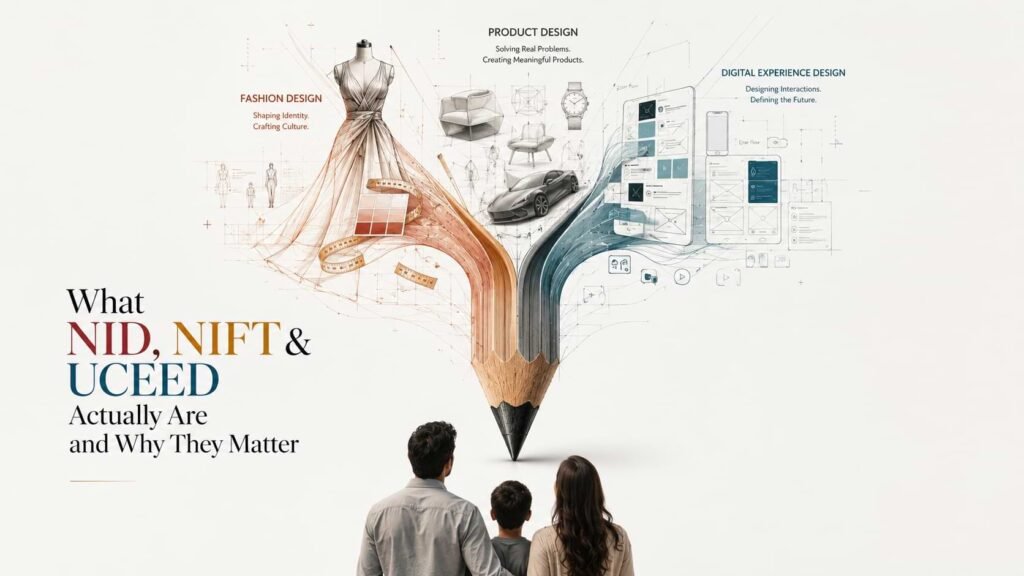
What NID, NIFT & UCEED Actually Are and Why They Matter
If your child has recently said, “I want to do design after Class 12,” chances are you have spent a few evenings navigating a maze of acronyms – NID, NIFT, UCEED, DAT, GAT, CAT – without a clear map. You are not alone. Thousands of Indian parents find themselves in exactly this position every year, and the confusion is completely understandable.
This guide is written for you. Not for the student who is already neck-deep in preparation, but for the parent who wants to understand what these exams actually are, whether a design career is worth pursuing, and how to genuinely support your child through this journey. If you have been wondering about the design entrance exams for students in India – what they test, which institutes they unlock, and what careers they lead to – read on. Every question you are afraid to ask is answered here.
What Exactly Are Design Entrance Exams?
Design entrance exams for students in India are national-level standardised tests that evaluate a student’s creative aptitude, visual reasoning, observation skills, and design thinking – rather than the rote knowledge tested by exams like JEE or NEET. These exams serve as the gateway to India’s most prestigious design institutions.
The three exams that matter most at the undergraduate level are:
- NID DAT – conducted by the National Institute of Design for admission to NID campuses
- NIFT Entrance Exam – conducted by the National Institute of Fashion Technology for its 19+ campuses across India
- UCEED – conducted by IIT Bombay for admission to B.Des programmes at IITs in Bombay, Delhi, Guwahati, and Hyderabad
Understanding what sets NID DAT, NIFT, and UCEED apart is the first step toward making an informed decision as a family. This is the NID entrance exam guide that every family deserves before they start the preparation journey.
| Did You Know? NID Ahmedabad is one of the only design institutes in India where admission is based entirely on creative aptitude – not academic marks. A student from any stream (Science, Commerce, or Arts) can apply, and Class 12 percentage carries no direct weightage in the final selection. What matters is how well your child thinks and responds as a designer. |
Understanding NID – India’s Premier Design Institution
What is NID?
The National Institute of Design (NID) is an autonomous institution under the Ministry of Commerce and Industry, Government of India. Established in 1961 in Ahmedabad, NID is today widely considered the country’s most respected design school, with additional campuses in Bangalore, Gandhinagar, Bhopal, Kurukshetra, Jorhat, Amaravati, and more.
The NID DAT Exam – An NID Entrance Exam Guide
The NID Design Aptitude Test (DAT) is a two-stage exam:
- DAT Prelims – a written test assessing design sensitivity, creativity, visual and spatial reasoning, and observation
- DAT Mains – a studio-based evaluation and personal interview for shortlisted candidates
There is no age limit for the B.Des programme, and students from any stream can apply after Class 12. Currently, NID offers approximately 425 seats for B.Des across all campuses – making it highly competitive. If you are wondering about the NID selection process, the honest answer is: consistent creative practice, observation of the world around you, and sustained design thinking – not coaching shortcuts.
What Does NID Look For?
NID does not want a student who can draw beautifully. It wants a student who can think like a designer – someone who notices problems in everyday objects, imagines alternatives, and can communicate ideas visually. Parents often worry their child is “not artistic enough.” The truth is that NID values observation, curiosity, and inventive thinking far more than technical drawing ability.
Also Read – NID India Top Design Institute: Why It Leads Design Education in India
Understanding NIFT – Fashion and Beyond
What is NIFT?
The National Institute of Fashion Technology operates 19 campuses across India and offers programmes in Fashion Design, Textile Design, Knitwear Design, Leather Design, Accessory Design, Fashion Communication, and Fashion Management, among others. NIFT is governed by the Ministry of Textiles and is consistently ranked among India’s top design institutions.
NIFT Entrance Exam Explained
The NIFT entrance exam has two components:
- GAT (General Ability Test) – mandatory for all applicants; tests English, quantitative ability, communication, and current affairs
- CAT (Creative Ability Test) – mandatory for B.Des and M.Des applicants; assesses creative thinking, visual ability, and design sense
Shortlisted B.Des candidates additionally appear in a Situation Test, where they are given raw materials and asked to create a three-dimensional structure. This stage tests hands-on creativity under time pressure. Looking at past NIFT entrance exam papers is one of the best ways to help your child understand what this stage actually demands.
NIFT has no stream restriction – a student from Science, Commerce, or Humanities can appear. For the NIFT entrance exam explained simply: it is less about fashion knowledge and more about creative perception and structured thinking.
Also Read – DIY Portfolio for NIFT Entrance Exam: What to Include & How to Stand Out
Understanding UCEED – The IIT Route to Design
What is UCEED?
The Undergraduate Common Entrance Examination for Design (UCEED) is conducted annually by IIT Bombay. It grants admission to B.Des programmes at IIT Bombay, IIT Delhi, IIT Guwahati, IIT Hyderabad, and IIITDM Jabalpur.
UCEED Exam Eligibility and Syllabus
Eligibility: Students who have passed Class 12 (from any stream) in the year of the exam or the preceding year are eligible. There is no age relaxation beyond this two-year window.
UCEED Exam Pattern:
- Part A (200 marks, 2 hours): Computer-based; includes Numerical Answer Type (NAT), Multiple Select Questions (MSQ), and Multiple Choice Questions (MCQ). Tests visualization, logical reasoning, observation, environmental awareness, and basic language ability.
- Part B (60 marks, 1 hour): Sketch-based drawing question testing creativity and observation.
For a detailed understanding of UCEED exam eligibility and syllabus, always refer to the official IIT Bombay admissions portal. Practising previous-year UCEED exam papers is highly recommended – they reveal the exact level of analytical and creative thinking the exam expects.
Unlike NIFT or NID, UCEED has a stronger analytical and reasoning component in Part A. Students with a Science background often find Part A more familiar, but the exam is absolutely not limited to Science stream students.
Also Read – How to Prepare for UCEED: Coaching, Study Material, & Online Classes Explained
| Did You Know? The combined applicant pool for NID DAT, NIFT, and UCEED runs into hundreds of thousands every year – yet NID has roughly 425 B.Des seats and UCEED admits fewer than 250 students across all IITs combined. The competition is real. But so is the reward. |
Is Design a Good Career Option for Your Child?
This is probably the question that brought you to this article.
Is design a good career option for my child in India? – The honest answer, in 2026, is yes – with the important caveat that it suits students who are genuinely curious, visually sensitive, and willing to build skills over time.
Here is what placement data tells us:
- NID Ahmedabad’s average placement package in the 2025 season was around ₹21.3 LPA, with the highest package reaching ₹30 LPA. Top performers across NID campuses have secured offers in the range of ₹40–50 LPA.
- NIFT graduates typically start between ₹15,000–₹50,000 per month depending on specialisation and campus, with experienced professionals in fashion, merchandising, and retail earning ₹5–22 LPA and senior professionals earning significantly more.
- IIT B.Des graduates through UCEED enter product design, UX/UI design, and interaction design roles at technology and consumer companies, where demand has grown substantially over the last five years.
Design career after Class 12 India is no longer a niche or “risky” path. Today, designers are employed by technology companies (Google, Microsoft, Flipkart, Nykaa), fashion houses, FMCG giants, automobile companies, government agencies, film studios, and global consulting firms. The field is broad, and it rewards people who keep learning.
Also Read – How Early Should Students Start Preparing for a Design Career? The Complete Roadmap for Students in India
NID vs NIFT vs UCEED – Which One is Right?
Parents often ask: “My child wants to do design – which exam should they target?” The answer depends on what kind of design interests your child.
| Exam | Best For | Conducting Body | Key Skill Tested |
| NID DAT | Product, industrial, communication, textile, game design | NID | Creative aptitude, studio thinking |
| NIFT | Fashion design, fashion communication, textile, knitwear | Ministry of Textiles | Fashion sense, creativity, GAT |
| UCEED | Product design, UX, interaction design at IITs | IIT Bombay | Analytical reasoning + creative aptitude |
Many serious design aspirants appear for all three – the exam calendars are staggered across the academic year, making it possible.
| Did You Know? You do not need a specific Class 11/12 stream to sit for any of these three exams. Science, Commerce, and Arts students are equally eligible. NID, NIFT, and UCEED specifically do not require Physics, Chemistry, or Maths – what matters is your child’s design thinking ability. |
What the Exams Actually Test – A Parent’s Quick Reference
One of the most common misconceptions is that design entrance exams test drawing skill. They do not – at least not exclusively.
Design entrance exams for students in India fundamentally evaluate:
- Visual reasoning – Can the student read and interpret spatial information?
- Observation – Does the student notice details others miss?
- Creative problem-solving – Can the student generate multiple ideas for an open-ended challenge?
- Design sensitivity – Does the student have an intuitive sense for proportion, colour, and form?
- Communication ability – Can the student express ideas clearly, both visually and verbally?
A child who has spent years filling sketchbooks with observations of the world around them – not just copying images – is far better prepared than someone who has done six months of coaching classes alone. When parents ask what is NID NIFT UCEED exam and how to prepare for it, the core answer is: build habits of seeing and thinking, not just practising drawing techniques.
The Preparation Journey – What Parents Need to Know
Understanding the design entrance exams for students in India is one thing. Supporting your child through preparation is another. A few practical realities parents often overlook:
Preparation is long. Serious candidates begin 12–18 months before the exam. Class 11 is the ideal starting point, though dedicated students beginning in Class 12 have also succeeded.
Coaching is useful but not mandatory. Reputed coaching institutes exist in most major cities and online. However, the quality of independent practice and self-driven learning often separates toppers from the rest. Looking at official previous-year NID DAT question papers is free, publicly available, and among the most effective preparation tools.
Stream does not matter – mindset does. Whether your child is in Science or Commerce, what matters is their willingness to observe, sketch, read widely, and stay curious. A student from Humanities who sketches daily has an equal – sometimes greater – advantage over a Science student who has never picked up a sketchbook.
Understanding how to get into NID is about more than strategy. Students who get selected into NID’s DAT Mains consistently describe it as a test of who they genuinely are as a thinker – not a test they cracked with tricks.
| Did You Know? NID DAT Prelims does not carry negative marking. This is intentionally designed to encourage risk-taking, imagination, and genuine creative expression – rather than safe, calculated answers. The exam wants your child to take creative leaps. |
A Guide to Supporting Your Child as a Parent
The parents guide to design college admission in India after 12th is not just about understanding exams – it is about being the right kind of support system. Here is what makes the biggest difference:
Validate the career choice early. When students feel uncertain about whether their parents believe in their path, it affects preparation confidence more than any syllabus gap.
Do not compare with engineering or medical paths. Design careers operate on a completely different trajectory – portfolio quality, creative reputation, and specialisation depth matter more over time than entrance rank.
Encourage observation as a daily habit. Ask your child to describe a product they used today, or critique the design of a space they visited. These conversations build design thinking in a natural, low-pressure way.
Visit design institute exhibitions. NID, NIFT, and some IIT design departments hold annual student exhibitions (graduation shows). Attending one is the single best way for parents and students to see what design education actually produces.
Stay informed about deadlines. The registration windows for NID, NIFT, and UCEED open and close on fixed dates annually. Missing an application window means waiting a full year. Keep a calendar.
Knowing how to support your child preparing for NID or NIFT entrance exam is less about managing their study schedule and more about creating an environment where creative thinking is respected and practiced daily.
Also Read – How to Support Your Child’s Creative Career Journey
Quick Comparison: NID, NIFT & UCEED at a Glance
| Feature | NID DAT | NIFT | UCEED |
| Conducted by | NID Ahmedabad | Ministry of Textiles / NTA | IIT Bombay |
| Stream required | Any | Any | Any |
| Exam stages | Prelims + Mains (Studio + PI) | GAT + CAT + Situation Test | Part A + Part B |
| Key focus | Design aptitude, studio thinking | Fashion + creative ability | Reasoning + design creativity |
| Institutes unlocked | NID campuses | 19 NIFT campuses | IIT Bombay, Delhi, Guwahati, Hyderabad |
| Approx. B.Des seats | ~425 | ~3,600+ | ~250 |
| Did You Know? Previous-year NID DAT question papers from official websites are publicly available. Solving them together with your child – even as a non-designer parent – helps you both understand what the exams genuinely demand. It often surprises parents how interesting and thoughtful these papers are. |
Frequently Asked Questions (FAQs)
Q1. Does my child need to be from a specific stream (Science/Arts/Commerce) to appear for NID, NIFT, or UCEED?
No. All three exams – NID DAT, NIFT entrance exam, and UCEED – are open to students from any stream. Class 12 marks are not a direct eligibility filter. What matters is your child’s creative aptitude and design thinking ability.
Q2. Is a design career financially stable in India?
Yes, increasingly so. NID placements in 2025 reported average packages of around ₹21 LPA at the Ahmedabad campus. NIFT graduates earn between ₹3–15 LPA at entry level depending on specialisation and campus, with experienced professionals earning significantly more. UCEED graduates entering UX and product design at tech companies command strong salaries from day one. The design career after Class 12 India is no longer a financial gamble – it is a structured professional path.
Q3. What is the best age to start preparing for design entrance exams?
Ideally, your child should begin building design awareness from Class 9 or 10 – sketching regularly, observing the designed world, and reading broadly. Structured preparation for design entrance exams for students in India typically begins in Class 11. Students starting in Class 12 can still succeed with focused, disciplined preparation.
Q4. Can my child appear for NID, NIFT, and UCEED in the same year?
Yes, and many serious aspirants do exactly this. The exam calendars are staggered across the year – typically, UCEED is held in January, NIFT in February, and NID DAT Prelims in late December to early January. Students can appear for all three without scheduling conflicts.
Q5. How is the NID DAT different from the NIFT entrance exam and UCEED?
The difference between NID DAT NIFT exam and UCEED for B.Des admission lies primarily in structure and focus. NID DAT is studio-based and deeply evaluates creative and design thinking through two stages (Prelims and Mains). The NIFT entrance exam has a fashion-oriented lens with a GAT component and a hands-on Situation Test. UCEED, conducted by IIT Bombay, has a stronger analytical and reasoning component (Part A) alongside a drawing test (Part B). Each exam suits different design interests and thinking styles.
Q6. My child has never taken formal coaching. Can they still crack these exams?
Absolutely. While coaching helps provide structure and exposure to question formats, self-prepared students regularly crack all three exams. The key is sustained practice – solving previous-year question papers, observing and sketching daily, and building genuine design awareness. Independent, self-driven practice and authentic creative development are what set successful self-prepared students apart.
Q7. What happens if my child does not clear these exams on the first attempt?
Both NID and UCEED allow students to appear for a limited number of attempts (check current official guidelines for age restrictions). More importantly, the preparation itself builds transferable skills – observation, creative thinking, visual communication – that serve students well in alternative design programmes, fine arts colleges, and private design institutes. A gap year for reattempt is not uncommon and is widely accepted in the design community.
Final Word for Parents
Design is not the easy path – nor is it the risky one it was once considered. The design entrance exams for students in India – NID DAT, NIFT, and UCEED – are rigorous, competitive, and genuinely rewarding for students who are suited to them.
Your child’s interest in design is worth taking seriously. The institutions these exams unlock are world-class. The careers they lead to are meaningful, financially viable, and growing in demand. And perhaps most importantly, the preparation journey itself – of observing more carefully, thinking more creatively, and expressing ideas more confidently – makes young people better thinkers regardless of the outcome.
If your family is navigating this process, the most valuable thing you can do right now is have an honest conversation – not about percentages or rankings, but about what genuinely excites your child about design. That answer will tell you everything you need to know about whether this is the right path.The design entrance exams for students in India are not gatekeepers to be feared. They are invitations to prove that your child sees the world differently – and knows how to shape it.