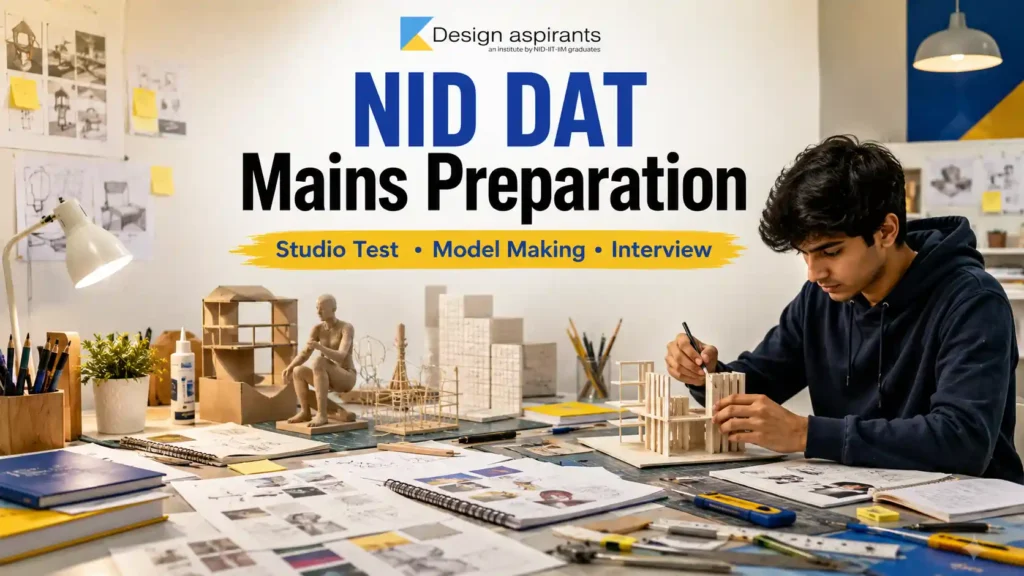
You cleared NID DAT Prelims. Now what? Many students from Indore feel confident after clearing Prelims – but then they realise: the real game has just started. NID DAT Mains preparation is where your rank actually gets decided. From 2026 onwards, the final merit list is based 100% on your Mains performance. Prelims? That was just the entry ticket.
So the question is – do you really know what happens inside the NID DAT Mains? What will they ask you? What do you need to build, sketch, or present? And how do students in Indore prepare for it without running to Ahmedabad or Bengaluru?
This guide answers all of that – clearly, honestly, and step by step.
Whether you are a Class 12 student appearing for B.Des or a graduate preparing for M.Des, this blog is your complete NID DAT Mains preparation roadmap.
What Is NID DAT Mains and Why Does It Matter More Than Prelims?
Before we get into preparation, let us understand what NID DAT Mains actually is.
After you clear DAT Prelims, NID shortlists a fixed number of candidates for Mains. As per the 2026 pattern, only 1.5 times the total available seats per category get called for Mains. So if there are 100 seats in the General category, only 150 candidates move forward.
That means the shortlist is tight – and once you are in, every mark in Mains counts.
NID DAT Mains preparation is important because:
- DAT Mains carries 100% weightage in the final result (as per the 2026 revised pattern)
- Prelims score has 0% contribution to your final rank
- Your admission to NID Ahmedabad, NID Bengaluru, NID Gandhinagar, NID Haryana, NID Madhya Pradesh, or NID Andhra Pradesh – all depends on your Mains performance
So if you scored well in Prelims but ignore Mains prep, you will not get selected. Simple as that.
Did You Know? In NID DAT 2026, the Studio Sensitivity Test and In-Person Sensitivity Test were conducted as two separate rounds under Mains. Only candidates who appeared in both tests were considered for the final merit list. Skipping even one round means you are out of the race – regardless of how well you performed in Prelims.
Also Read – How to Crack the NID DAT Exam with Smart Strategies
What Is the Structure of NID DAT Mains? (B.Des vs M.Des)
NID DAT Mains is not the same for B.Des and M.Des students. Here is the clear difference:
| Component | B.Des | M.Des |
| Studio Sensitivity Test | Yes | Yes |
| In-Person Sensitivity Test | Yes | Yes |
| Personal Interview | Not required | Yes |
| Portfolio Submission | Not required | Required |
| Final Weightage | 100% Mains | 100% Mains |
For B.Des students, the Mains has two parts – Studio Sensitivity Test and In-Person Sensitivity Test. Both are conducted at designated NID campuses.
For M.Des students, there are three parts – Studio Test, Personal Interview, and Portfolio review. The interview component carries significant weightage, especially in the 2027 pattern where communication and design thinking matter more than ever.
Both exams are conducted in offline mode at NID campuses. You will need to travel to the allotted NID centre. Your admit card mentions the city and venue.
What Activities Are Included in NID Studio Test? (Step by Step Breakdown)
This is the question every student wants answered. What actually happens inside the NID studio test?
Let us go through it task by task. Note that NID does not officially release a fixed syllabus for the studio test – so this breakdown is based on previous year papers and verified student feedback.
1. Model Making (3D Construction)
NID Mains model making tips – this is the most important task in the studio test. You will be given a set of materials and asked to build a 3D model within a time limit.
Materials that have been provided in past years include:
- Paper and cardboard
- Clay (terracotta or regular)
- Wire (aluminium or regular)
- Thermocol
- Ice cream sticks
- Rubber bands
- Straws
- Cloth pieces
- Pins and threads
- Plaster of Paris
A real question from NID B.Des Studio Test 2026: “Some materials were given to students and they were asked to create a stable model without using any glue or adhesives.”
Other past questions include: design a chair for a child using paper and straws, create a moving toy using bamboo sticks and thread, build a portable shelter for a street vendor.
What does NID check here? They check how you handle materials, whether your model is stable and logical, and whether your solution shows original thinking. Perfection is not the goal – design thinking is.
2. Doodling and Quick Sketching
NID Mains doodling exercises test how fast your creative mind works. You may be given a set of incomplete shapes or lines and asked to complete them into meaningful visuals within minutes.
A common format: 12 boxes are given, each with a different line or scribble. You have to fill each one and make it a complete drawing or visual story.
This task tests your spontaneity, observation, and ability to find meaning in random forms. There is no wrong answer – but there is a clear difference between a mechanical fill and a creative, thoughtful doodle.
Sketching practice for beginners: Start with 10-minute daily doodle sessions. Take any random shape and turn it into 5 different objects. This builds the creative muscle NID is looking for.
3. Audio-Visual Perception Test
This task checks how observant you are. A short video clip (30 seconds to 3 minutes) is shown or an audio clip is played. You are then asked questions based on what you saw or heard.
A real NID B.Des Studio Test 2026 question: “A black bag was given which had some materials – ghunghroo, wooden block, cloth and rope. Students were asked to feel the materials without actually seeing them and write the materials and their dimensions using their memory and observation skills.”
This tests your sensory awareness and memory. NID wants designers who pay attention to detail in their surroundings.
4. Write-Up or Storytelling Task
You may be asked a situational or emotional question and asked to write a short response or illustrate it through visuals.
An actual question from NID B.Des Studio Test 2026: “When you feel stuck in life – how do you overcome that?”
This is not a language test. NID uses this to understand how you think, how you express yourself, and whether you have the emotional maturity to become a designer.
5. Psychometric or Scenario-Based Tasks
These tasks test your lateral thinking. For example: you might be asked what you noticed on your way from home to the exam centre. Or you might be given a situation – like designing something for a visually impaired person – and asked to sketch or write your solution.
NID studio test preparation for this type of question: start observing your environment daily. On your way to school, your coaching class, the New Palasia area – notice details. What signs, textures, interactions catch your attention? Write them down. This habit is what makes you score in this round.
Also Read – Common Mistakes Students Make While Preparing for NID
What Materials Are Allowed in NID Studio Test for Model Making?
This is one of the most searched questions – and the answer depends on what NID provides at the test centre.
Here is the important part: you do not bring materials for model making. NID provides the materials to all students at the start of the studio test. Every student gets the same material pack.
Materials that have been included in past NID studio test sessions:
- One large white sheet + colour A4 sheets (light blue, brown, red, yellow, dark green)
- Clay, wire, cardboard, thermocol
- Scissors, rubber bands, straws, pins, threads
What you should carry on the day:
- Blue/black ball-point pen
- Lead pencils (varying grades – HB, 2B, 4B)
- Colour pencils, oil pastels, sketch pens
- Eraser, sharpener, ruler
- Transparent writing pad
- Printed admit card + valid photo ID
No mobile phone, calculator, electronic gadgets, or correction fluid is allowed.
Did You Know? NID has the authority to change the studio test format at any time. They can make it fully online or change the type of tasks without prior notice. This is why your core skills – creativity, observation, material handling, quick thinking – matter more than memorising a fixed pattern. Prepare the skill, not just the format.
How Is NID DAT Mains Different from Prelims in Terms of Preparation?
This is a critical question – and most students do not prepare for Mains the right way because they treat it like an extension of Prelims.
Here is the difference:
| Aspect | DAT Prelims | DAT Mains |
| Format | Written (objective + subjective) | Hands-on, physical, sensory |
| Skills Tested | Drawing, visualization, design awareness | 3D thinking, material handling, observation, communication |
| Time | 2.5 to 3 hours | 2.5 to 3 hours (studio) + interview (M.Des) |
| Location | Exam centres across India | NID campuses only |
| Weightage | 0% in final result | 100% in final result |
| Preparation | Practice papers, timed drawing exercises | Daily hands-on practice, material exploration |
In Prelims, you are answering questions on paper about design. In NID DAT Mains, you are actually designing. You are building, thinking, sensing, and creating in real time.
This is why NID DAT Mains preparation requires a completely different approach. You cannot prepare for it by reading notes or watching tutorials alone. You have to practice physically, every single day.
Also Read – How to Create an Impressive NID Portfolio and NIFT Portfolio
How to Prepare for NID DAT Mains Studio Test – 7 Daily Habits That Actually Work
If you are in Indore and preparing for NID DAT Mains, here is what your daily practice should look like:
1. Daily 20-Minute Sketch Practice
Set a timer. Pick one object in your room and sketch it from three different angles. Do not aim for a perfect drawing – aim for a clear visual representation. This builds the quick sketching ability that NID tests in the studio.
2. Weekly Model Making Sessions
At home, gather basic materials – old newspapers, cardboard, wire, rubber bands, clay. Give yourself a question (like “build a bridge that can hold a book”) and make a model in 45 minutes. Practice without adhesive – NID often restricts glue use.
3. Daily Observation Notes
On your way to coaching or college, notice 5 things around you – a shadow pattern, the way a vendor arranges their goods, the shape of a signboard. Sketch or write them down. This directly prepares you for the psychometric round of the studio test.
4. Doodle Journal
Keep a small sketchbook. Every morning, fill 2-3 boxes with doodles starting from a random scribble. This is exactly how NID tests your NID Mains doodling exercises – and daily practice makes you faster and more confident.
5. Audio-Visual Practice
Watch a short 2-minute video (a nature clip, a street scene) and then write down everything you noticed – colours, sounds, objects, actions. Gradually reduce the video length to 30 seconds. This builds your memory and sensory attention for the audio-visual test.
6. Solve Past Studio Test Papers
While NID does not officially release papers, coaching institutes and online platforms like Careers360, Shiksha, and Design Aspirants have compiled memory-based questions from past years. Solve at least 2 past studio test papers per week.
7. Timed Practice Under Pressure
One of the biggest mistakes students make: they practice without time limits. In the actual studio test, you have 2.5 to 3 hours for 3-4 tasks. Start practicing everything under time pressure from Day 1.
Is Portfolio Compulsory for NID B.Des DAT Mains Interview?
Short answer: No, portfolio is not required for B.Des. B.Des Mains only includes the Studio Sensitivity Test and In-Person Sensitivity Test. There is no personal interview or portfolio round for B.Des candidates.
For M.Des candidates, portfolio is an essential part of the Mains. Here is what the M.Des interview involves:
- A personal interview conducted by a panel of NID faculty and industry experts
- Portfolio review – you present your best design work to the panel
- Discussion on your design choices, thought process, and career goals
- The panel assesses your creative mindset, communication, personality, and domain knowledge
NID Interview Preparation Tips for M.Des Students
What does the panel actually ask in the interview?
Based on verified student accounts and alumni feedback, common NID interview questions include:
- Tell us about yourself and why you want to study design at NID
- Walk us through your portfolio – explain your best project
- What design problem in your everyday life bothers you the most?
- If you had to redesign one product you use daily, what would it be and why?
- Which designer or design movement has influenced you the most?
- What do you think is the role of design in solving social problems in India?
How to build a strong portfolio for NID M.Des:
- Include your best 8-12 works – do not overstuff
- Show variety: sketches, design concepts, photography, models, digital work
- Organize under themes – for example, “Sustainability Projects”, “Everyday Problem Solving”
- Include process pages (rough sketches, ideation stages) – NID values thinking, not just polished output
- Portfolio can be physical (spiral bound, A3 size) or digital (PDF on tablet)
- Keep presentation clean, clear, and purposeful
NID interview preparation tips: Practice presenting each project in 90 seconds. Say – what was the problem, what was your approach, and what did you learn. Keep it focused, honest, and free of jargon.
Did You Know? NID does not have a dress code for the interview round. You can wear what you are comfortable in. However, appearing neat, calm, and confident matters. The panel is looking for a designer’s personality – curious, observant, expressive – not a corporate look.
What Are the Most Common Mistakes Students Make in NID DAT Mains Preparation?
These are the mistakes that cost students their rank – even after clearing Prelims:
Mistake 1: Treating Mains like an extension of Prelims Prelims was a written test. Mains is hands-on. Students who keep practicing drawings and sketches but never touch clay or wire go blank in the studio test.
Mistake 2: Not timing their practice Most students practice without a clock. But in the actual test, time runs out fast. If you cannot make a 3D model in 45 minutes at home, you will struggle in the exam hall.
Mistake 3: Ignoring the sensory and write-up tasks Many students focus only on model making and sketching. They completely ignore the audio-visual test and write-up round – and then lose marks on these “easier” sections.
Mistake 4: Last-minute preparation After Prelims results, you typically get 2-4 weeks before the studio test date. That is not enough time to build material handling skills from scratch. NID DAT Mains preparation should start at least 2-3 months before Prelims results.
Mistake 5: Not knowing the B.Des vs M.Des difference B.Des students do not need a portfolio or interview preparation. M.Des students do. Mixing up the two preparation strategies wastes valuable time.
Also Read – NID Entrance Exam Syllabus: A Complete Guide for Aspirants
How Can Students in Indore Prepare for NID DAT Mains?
Students in Indore have a real advantage – if they use it right.
The challenge for Indore students is usually the same: lack of a structured Mains preparation program, and uncertainty about what to practice and how. Most generic coaching programs focus only on Prelims.
At Design Aspirants Indore (2nd Floor, 27/2, RS Bhandari Marg, near 56 Shop, New Palasia), the NID DAT Mains preparation program is built specifically around what actually happens in the studio test. Students get:
- Hands-on model making sessions with real materials – clay, wire, paper, thermocol
- Timed doodle and quick sketch exercises modelled on actual past NID questions
- Audio-visual practice sessions with trained faculty feedback
- M.Des students get portfolio development guidance and mock interview rounds
- Past 10 years of NID studio test memory-based questions for practice
The biggest advantage of preparing for NID coaching Indore for studio test locally is consistent practice. You cannot build material handling skills in a 10-day crash course. You need weekly, supervised sessions over 2-3 months.
If you have cleared Prelims and are now looking at Mains preparation, or if you are a student planning early – starting your NID DAT Mains preparation with structured guidance in Indore is the smartest move.
NID DAT Mains Preparation Checklist – What to Do Week by Week
Here is a simple, practical checklist for students preparing for NID DAT Mains 2027:
Months 1-2 (Foundation Phase):
- Understand B.Des vs M.Des Mains structure clearly
- Start daily sketching – 20 minutes every morning
- Begin weekly model making sessions at home with basic materials
- Start a doodle journal – 10 minutes daily
- Begin observation habit – note 5 things daily from your surroundings
Month 3 (Practice Phase):
- Solve 2 past NID studio test papers per week under timed conditions
- Practice audio-visual memory exercises (short video → recall)
- Attempt full mock studio test sessions (2.5 hours, all task types)
- M.Des students: start curating portfolio pieces
- Get feedback on your models and sketches from a trained mentor
Final 2 Weeks (Refinement Phase):
- Focus on time management – complete every task 5 minutes early
- Practice write-up tasks on random topics (2 per week)
- M.Des students: mock interview practice – at least 2 full sessions
- Confirm your admit card details, travel, and accommodation at the NID campus city
- Carry all required materials as per the official admit card instructions
Also Read – Self-Study vs Coaching for NID: Which Preparation Method Works Best?
People Also Ask – Quick Answers
Q1: What activities are included in NID DAT Mains studio test? NID studio test includes 3D model making, doodling and quick sketching, audio-visual perception test, write-up or storytelling tasks, and psychometric/scenario-based exercises. Exact questions vary every year – NID does not repeat them.
Q2: What materials are allowed in NID studio test for model making? NID provides all materials for model making at the centre – clay, wire, paper, cardboard, thermocol, straws, rubber bands, and more. You do not bring your own. Carry pencils, colours, eraser, ruler, and writing instruments as per the admit card.
Q3: How long is the NID DAT Mains studio test and how many questions come? The studio test is approximately 2.5 to 3 hours long. Based on past years, 3 to 4 questions are asked covering different task types. Each task typically has sub-parts.
Q4: Is portfolio compulsory for NID B.Des DAT Mains interview? No. B.Des Mains does not include any interview or portfolio round. Only M.Des candidates are required to appear for an interview and portfolio review as part of the DAT Mains process.
Q5: How is NID DAT Mains different from Prelims in terms of preparation? Prelims is a written test of design awareness and creative drawing skills. Mains is entirely hands-on – 3D model making, material handling, sensory tests, and (for M.Des) a personal interview. Preparation strategies are completely different. Mains requires daily physical practice with materials, not just paper-based exercises.
Final Word: Why NID DAT Mains Is Where Your Seat Gets Decided
If you are reading this, you already know that clearing Prelims was the beginning, not the end.
NID DAT Mains preparation is where most students either rise or fall. The studio test does not test how much you studied – it tests how you think, how you create, and how you handle the unexpected with confidence.
Students from Indore who prepare consistently, build real material handling skills, and understand what NID is actually looking for – they are the ones who get the call letter.
Start your NID DAT Mains preparation early, practice with real materials, and if you need structured guidance, you know where to find us.
📍 Design Aspirants – Indore 2nd Floor, 27/2, RS Bhandari Marg, Near 56 Shop, New Palasia, Indore
📞 +91-7447004300
Preparing students from Central India for NID, NIFT, UCEED, CEED, NATA, and IIT B.Arch