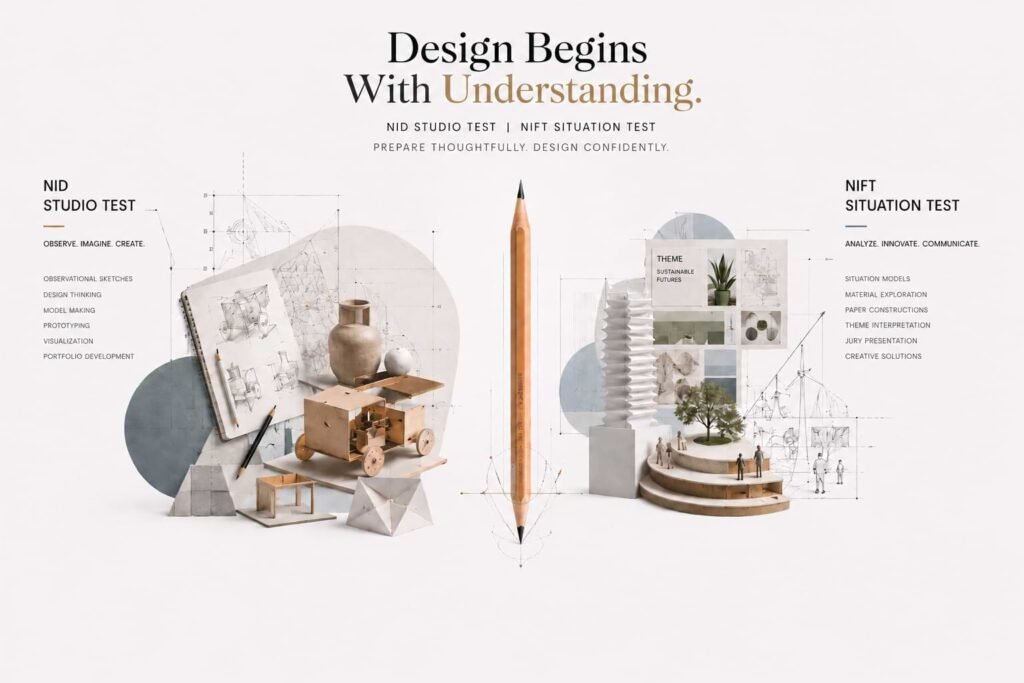
For every aspiring design student in India, the practical examination round is the true proving ground. The debate around NID Studio Test vs NIFT Situation Test is one of the most searched topics among design entrance aspirants – and for good reason. Both tests assess creative intelligence, spatial reasoning, and material handling, yet they differ significantly in structure, expectations, scoring, and the kind of designer each institution is trying to identify.
This guide covers everything you need: format, NID mains studio test evaluation criteria, NIFT jury expectations, NID studio test preparation tips, and a complete preparation roadmap for 2027. Read on to walk into your exam fully prepared.
What Is the NID Studio Test? A Complete Overview
The National Institute of Design (NID) is among India’s most prestigious design institutions, offering programmes in Industrial Design, Communication Design, Textile Design, and more. Shortlisted candidates who clear the NID DAT Prelims appear for the NID DAT Mains – the Studio Test.
The NID Studio Test is a multi-day in-person evaluation spanning two days:
- Day 1 – Studio tasks: model making, material exploration, observational drawing, and design briefs.
- Day 2 – Personal Interview: candidates present their portfolio and defend their design thinking.
NID Studio Test marks weightage 2027: The Studio Test combined with the PI holds approximately 70-80% of the final selection weightage depending on the programme, making it the single most critical stage in NID admissions.
| Did You Know? NID was established in 1961 by the Government of India in collaboration with the Ford Foundation, making it one of Asia’s oldest and most respected design schools. Its Ahmedabad campus is a UNESCO-recognised institution. |
NID Studio Test tasks are deliberately open-ended. Examiners assess how a candidate thinks, not just what they produce – deep design thinking and material sensitivity matter far more than technical polish.
Also Read – Is NID Coaching Worth It in 2027? Honest Breakdown
What Is the NIFT Situation Test? A Complete Overview
The National Institute of Fashion Technology (NIFT) conducts the Situation Test as part of its B.Des selection process, held after the written examinations (GAT + CAT) for shortlisted candidates.
NIFT Situation Test is a single-day practical exam lasting approximately 3-4 hours. Candidates receive a standardised material kit – typically including paper, cardboard, threads, pins, adhesives, and craft supplies – and must create a 3D model or installation based on a given situational theme.
After building the model, candidates present it verbally to a jury – explaining their concept, material decisions, and design intent. This dual component sets the NIFT Situation Test apart from purely hands-on evaluations.
| Did You Know? The NIFT Situation Test accounts for approximately 50% of the final B.Des selection score – equal in weight to the entire written examination. This makes it impossible to qualify without genuinely strong practical performance. |
For students planning their NIFT situation test preparation 2027, it is essential to understand that the jury evaluates both the physical output and verbal communication with equal rigour. A visually impressive model explained poorly will cost you marks just as surely as a weak model would.
Also Read – NIFT Situation Test 2027: What Judges Actually Look For
NID Studio Test vs NIFT Situation Test: Side-by-Side Comparison
Understanding what is the difference between NID studio test and NIFT situation test starts with a clear comparison. Both tests measure creative aptitude and practical skill, but diverge sharply in format, duration, and evaluation philosophy.
| Aspect | NID Studio Test | NIFT Situation Test |
| Duration | 2 days (Studio + Personal Interview) | 1 day (approx. 3-4 hours) |
| Format | Model making, sketching, material tasks | 3D model making + jury presentation |
| Materials | Supplied on-site at NID campus | Standardised kit given at venue |
| Group vs Individual | Individual | Individual |
| Final Score Weightage | High-drives shortlisting for PI | Approx. 50% of total NIFT score |
| Evaluation Focus | Design thinking, innovation, craft, aesthetics | Concept, material use, communication |
| Verbal Component | High-detailed Personal Interview | Jury presentation after model-making |
| Sketching Required | Yes, detailed observational drawing | Optional but beneficial |
| Result Announced | Post Personal Interview | Combined with written score for merit list |
This comparison makes clear that the NID Studio Test vs. the NIFT Situation Test is not merely a question of difficulty level – it is a fundamental difference in what type of designer each institution is identifying. NID looks for design thinkers; NIFT looks for material-savvy creative communicators.
NID Mains Studio Test Evaluation Criteria: What Do Judges Look For?
The NID mains studio test evaluation criteria are holistic and deliberately multi-dimensional. Examiners are senior NID faculty and design professionals assessing candidates across several parameters:
1. Design Thinking and Problem-Solving
Judges evaluate how systematically a candidate identifies the core of a problem and approaches it with intent. Random creativity without a process rarely scores well.
2. Material Sensitivity and Craft
How you handle clay, cardboard, or wire reveals tactile intelligence. Clean joins, structural integrity, and appropriate material choices all matter.
3. Originality and Innovation
Playing it safe is penalized. Conceptual novelty- even with slightly rough execution – is rewarded over technically polished but generic work.
4. Aesthetic Sensibility
Visual balance, proportion, color harmony, and overall composition all contribute here. NID expects students to have a naturally refined visual eye.
5. Communication in the Personal Interview
Your ability to articulate your process and defend design choices in the PI is decisive. Students at a NID coaching in Bhopal centre should make PI mock sessions a core part of their training.
| Did You Know? NID evaluators are not looking for the most beautiful model – they want the most thoughtful one. A simple, well-reasoned creation consistently outscores a complex but unexplained one. |
These NID mains studio test evaluation criteria apply uniformly across all NID campuses and programmes, though the specific tasks may vary. Understanding them deeply is the first step in building a focused preparation strategy.
NIFT Situation Test Evaluation Criteria: What Do Judges Look For?
When asking what do judges look for in NID studio test and NIFT situation test, NIFT jury priorities differ from NID’s:
- Concept and Idea: Is the theme interpreted interestingly? Does the model express a clear, communicable idea?
- Use of Given Materials: How creatively and efficiently are the provided materials used? Wastage is noted negatively.
- 3D Modelling Skills: Structural integrity, spatial understanding, and overall craftsmanship of the model.
- Visual Appeal: Colour, texture, surface treatment, composition, and overall presentation quality.
- Verbal Presentation: Can you confidently explain your concept, material choices, and design decisions to the jury?
- Time Management: Did you complete the model within the allotted time? Incomplete work is heavily penalised.
Students from top NIFT coaching in Bhopal and NIFT coaching in Indore centres are trained extensively on the presentation component, which many self-preparing candidates neglect. Never underestimate jury interaction – it can elevate a mediocre model or diminish a great one.
Which Is Tougher – NID Studio Test or NIFT Situation Test?
The answer to which is tougher NID studio test or NIFT situation test depends on your strengths. Here is a clear breakdown:
NID Studio Test Is Tougher If You…
- Struggle with open-ended, ambiguous problem statements
- Have underdeveloped observational drawing and sketching skills
- Are not confident in verbal communication or defending your creative choices
- Lack exposure to diverse materials and craft techniques
NIFT Situation Test Is Tougher If You…
- Are not comfortable working strictly within given material constraints
- Have weak 3D modelling or spatial construction skills
- Find it difficult to explain creative decisions under jury pressure
- Struggle with time management during practical tasks
Overall in the NID Studio Test vs NIFT Situation Test comparison, NID has a longer and more subjective evaluation spread over two days. NIFT is more condensed and structured – more manageable with targeted preparation, but equally competitive.
| Did You Know? Only 10-15% of NID written exam qualifiers make it through the Studio Test to the final merit list, depending on the programme and campus. NIFT Situation Test shortlisting is based on written scores, and the practical round is equally high-stakes. |
NID Studio Test Preparation Tips: How to Build Exam-Ready Skills
Effective NID studio test preparation tips begin with one key insight: this test cannot be crammed. It demands sustained, deliberate practice over months. Here is a structured approach:
Build a Daily Sketching Habit
Spend 30-45 minutes every day on observational drawing. Sketch objects, people, spaces, and mechanisms from life. Train your hand to accurately record what your eye sees.
Practice Material Manipulation Regularly
Work with cardboard, clay, foam, paper, and wire. Build small models – furniture, tools, abstract forms. Focus on clean construction, structural stability, and proportion. Document your process in a design journal.
Develop Design Thinking Frameworks
Study design thinking methodologies – empathy mapping, ideation, rapid prototyping. Practice solving open design briefs within time limits. This is a skill that can only be built through repetition.
Build a Strong, Process-Driven Portfolio
Your portfolio is central to the NID PI. It should reflect genuine curiosity and experimentation – include process documentation, iterations, and failures, not just polished final outcomes.
Mock Studio Sessions with Expert Feedback
At least two months before the exam, begin full-length mock studio sessions under timed conditions. Whether you access these through a NID coaching in Bhopal, NID coaching in Indore, or any other reputed centre, expert critique during mock sessions is irreplaceable.
Study Design History and Vocabulary
Know your design icons – Dieter Rams, Charles Eames, Saul Bass – and key movements like Bauhaus and Modernism. Contextualising your work within design history consistently impresses NID interviewers.
These NID studio test preparation tips apply whether you are a first-time aspirant or a repeat candidate. The difference between those who clear the Studio Test and those who do not almost always comes down to the depth and consistency of preparation.
NIFT Situation Test Preparation 2027: A Practical Roadmap
Focused NIFT situation test preparation 2027 is more structured than NID prep because the test format is relatively predictable year to year. Here is how to build the right skillset:
Master the Material Kit
NIFT provides a standardised material kit at the venue. Practise with those exact materials – understand their flexibility and joining techniques, and know what you can build efficiently in under 3.5 hours.
Practice Themed 3D Model Making
NIFT issues a situational theme each year – nature, technology, architecture, emotion, etc. Practise building models for varied themes to develop a strong personal visual vocabulary.
Develop Your Verbal Presentation Skills
After every practice model, describe it aloud for 2-3 minutes: the concept, how materials support it, and key design decisions. Record and review yourself critically each time.
Improve Time Management
Practise completing a full model in under 3.5 hours, leaving time for finishing touches and presentation prep. Many students lose marks simply by running out of time – incomplete work is penalised heavily.
Students enrolled at NIFT coaching in Bhopal and NIFT coaching in Indore institutes that conduct mock situation tests with jury feedback consistently outperform self-preparing candidates. Real-time expert critique on your model and presentation is far more valuable than self-assessment alone.
Preparing for Both NID and NIFT Practical Tests: A Combined Strategy
Many aspirants target both, and how to prepare for NID studio test and NIFT situation test together has a largely unified answer – the foundational skills overlap significantly.
Here is a combined month-by-month preparation roadmap:
- Months 1-2 – Foundation Building: Daily sketching, material exploration, and study of design history and vocabulary.
- Months 3-4 – Skill Specialisation: NID focus on design thinking depth and sketching; NIFT focus on 3D modelling and jury presentation practice.
- Months 5-6 – Mock Tests: Full-length simulated NID studio sessions and timed NIFT situation tests with expert evaluation and portfolio refinement.
- Final Month – Consolidation: Portfolio review, PI mock sessions, and situation test dry runs under real material constraints.
Institutes offering integrated NID and NIFT programmes – including reputed NID coaching in Bhopal and NIFT coaching in Bhopal centres – are ideal for this dual-preparation approach. Students in central India also benefit from strong NID coaching in Indore options that have consistently produced results for aspirants targeting both exams simultaneously.
Also Read – Parents’ Guide to Design Entrance Exams
Common Mistakes to Avoid in Both Tests
Knowing the NID Studio Test vs NIFT Situation Test differences also means understanding the pitfalls that cost students marks every year:
Mistakes in NID Studio Test
- Over-complicating the brief – keep your response focused and intentional
- Neglecting the Personal Interview – a brilliant model means little if you cannot explain it
- Poor portfolio quality – rushed or undocumented work damages your PI performance
- Mimicking trending design styles instead of developing an original, personal voice
Mistakes in NIFT Situation Test
- Starting construction without a clear concept – leads to aimless, unfocused models
- Neglecting the verbal component – your explanation is worth as much as your model
- Poor time management – unfinished models are heavily penalised by the jury
- Using many materials superficially rather than using fewer materials thoughtfully and deliberately
| Did You Know? Both NID and NIFT follow a process-oriented evaluation philosophy. They do not want students who produce perfect results – they want students who can articulate clearly why they made every single decision in their work. |
The Role of Coaching in NID and NIFT Practical Test Preparation
Coaching plays a significant role here – not because creativity can be taught, but because structure, feedback, and simulated exam conditions make a measurable difference. The best NID coaching in Bhopal and NIFT coaching in Bhopal institutes provide expert critique on your work, repeated mock tests, and a competitive peer environment that sharpens performance in ways self-study simply cannot replicate. Students across Madhya Pradesh accessing quality NID coaching in Indore and NIFT coaching in Indore centres benefit from faculty who understand NID and NIFT evaluation standards and keep aspirants focused on what actually matters.
Frequently Asked Questions (FAQs)
Q: What is the main difference between the NID studio test and NIFT situation test?
A: The NID Studio Test is a two-day intensive evaluation combining studio tasks (model making, sketching, design problems) with a Personal Interview. It strongly emphasises design thinking and conceptual depth. The NIFT Situation Test is a single-day practical exam focused on 3D model creation using provided materials, followed by a verbal jury presentation. NID tests design problem-solving ability; NIFT tests material creativity and communication confidence.
Q: What is the NID Studio Test marks weightage in 2027?
A: The NID Studio Test (DAT Mains) combined with the Personal Interview typically holds 70-80% of the final selection weightage. This figure may vary slightly by discipline and campus in 2027, but the practical round always dominates selection criteria. Students must treat the Studio Test as the primary battleground for their NID seat.
Q: How should I approach NIFT situation test preparation for 2027?
A: Strong NIFT situation test preparation 2027 comes down to three priorities: intensive practice with the venue-provided material kit, consistent timed 3D model building across varied themes, and deliberate verbal presentation practice for the jury. Coaching centres in Bhopal and Indore offering mock situation tests with jury feedback give you the most targeted preparation available.
Q: Can I prepare for both NID and NIFT practical tests at the same time?
A: Yes – the core skills overlap significantly: sketching, material handling, design thinking, and verbal articulation are directly transferable across both exams. A structured integrated plan lets you prepare for both the NID Studio Test and the NIFT Situation Test efficiently, without doubling your effort.
Q: What do NID and NIFT judges actually look for in practical tests?
A: NID judges prioritise design thinking, originality, material sensitivity, and clear articulation of your process in the PI. NIFT jury members focus on concept clarity, efficient use of provided materials, 3D construction quality, and confident verbal explanation. Both institutions reward students who know exactly why they made every decision.
Final Thoughts
The journey to a seat at NID or NIFT is among the most demanding challenges an Indian design aspirant faces. The NID Studio Test vs NIFT Situation Test comparison ultimately reveals two distinct visions of design excellence – NID rewards deep, conceptual, process-driven thinking; NIFT rewards material creativity, spatial imagination, and communicative confidence.
Both tests, however, share a single underlying philosophy: they want designers who know why they create, not just how. Whether you are building a model in an NID studio or presenting your situation test creation to a NIFT jury, the question – “Why did you make this?” – will always be at the heart of your evaluation.
Start your preparation early, stay consistent, and seek expert mentorship – whether through NID coaching in Bhopal, NIFT coaching in Bhopal, NID coaching in Indore, or NIFT coaching in Indore. Build not just your skills, but your design voice. That is what will carry you through both tests and into a design career worth having.