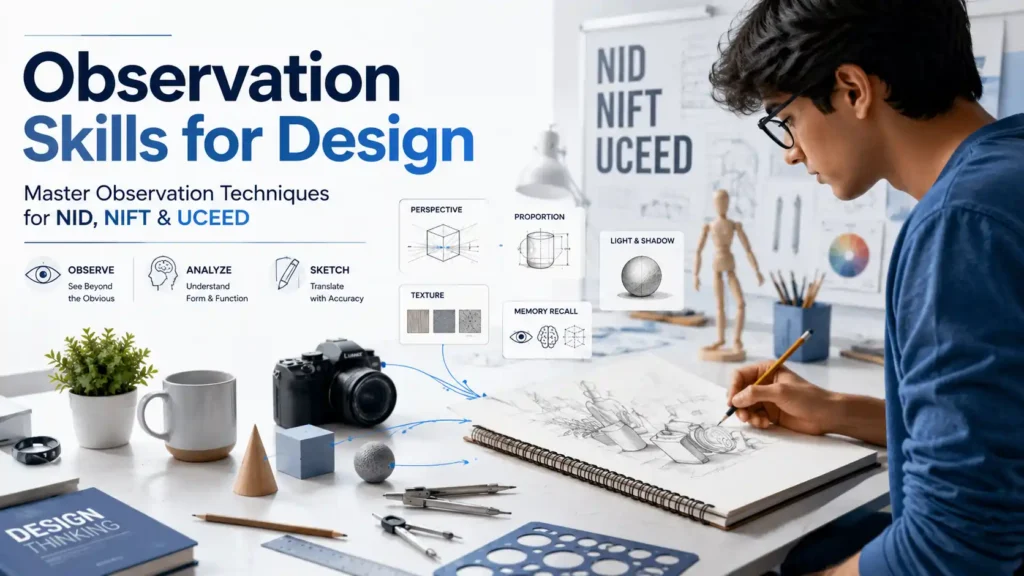
Observation skills for design are the ability to notice, analyze, and recall visual details – shape, proportion, light, shadow, texture, and spatial relationships – accurately enough to reproduce or apply them in a design task. For NID, NIFT, and UCEED aspirants, this single skill quietly decides how well you perform in sketching, situation tests, and studio-based rounds. Most students focus on drawing speed or shading technique, but examiners are actually testing how closely you see the world before you draw it.
This guide breaks down exactly how to build this skill through daily exercises, exam-specific practice, and structured training – whether you’re preparing alone or with a mentor.
What Are Observation Skills in Design?
Observation skills for design refer to a design student’s capacity to consciously study an object, scene, or situation and translate its details – form, proportion, texture, and context – into accurate visual or written output. Unlike casual seeing, this is active, deliberate noticing.
- Recognizing proportion and scale between objects
- Reading light and shadow direction correctly
- Remembering fine details after brief exposure
- Connecting visual cues to context or emotion
Why Observation Skills Matter for Design Entrance Exams
Every major design entrance exam is built around observation in some form. NID’s Studio Test asks candidates to recall and sketch objects or scenes from memory, sometimes involving sensory cues like sound, smell, or touch. NIFT’s situation test evaluates how well a candidate observes a real-world scenario and communicates it through a 3D model or written response. UCEED’s drawing section similarly rewards candidates who can capture proportion and detail accurately under time pressure.
In all three cases, the exam isn’t just checking artistic skill – it’s checking how well you process and retain visual information, which is exactly what strong observation training builds.
How to Develop Observation Skills for NID Exam
To develop observation skills for NID exam, practice daily object-recall sketching, timed memory drawing, and detail-spotting exercises for at least 20-30 minutes. Study real objects closely for 60-90 seconds, then reproduce them from memory. Consistency over weeks matters more than long single sessions.
Daily Visual Awareness Exercises
Building visual awareness exercises for designers into your daily routine is what actually moves the needle, not occasional practice before the exam.
- 60-second object study: Look closely at any object for one minute, then sketch it from memory
- Commute observation: Mentally note 5 new details on your regular route each day
- Photo-memory test: View a photo for 10 seconds, then list every detail you recall
- Blind contour drawing: Draw an object without looking at your paper, to train hand-eye-brain coordination
- Detail journaling: Write down 3 things you noticed today that you’d normally overlook
Observation Skills Exercises for Design Students
Beyond daily habits, structured observation skills exercises for design students help build the specific muscle needed for entrance exams. These exercises focus on speed, accuracy, and recall under time constraints – the exact conditions you’ll face in a studio test. Practicing observation skills for design in a structured format, rather than randomly, ensures you’re training the skill the exam actually measures.
- Compare-and-contrast sketching: Draw two similar objects side by side, highlighting subtle differences
- Time-boxed sketching: Give yourself 5 minutes to observe and 5 minutes to draw from memory
- Reverse storytelling: Study a scene, then write a short narrative based only on visual clues
- Texture mapping: Identify and label 5 different textures in a single room
- Proportion drills: Practice estimating height, width, and scale ratios between everyday objects
Observation Skill Practice for NIFT UCEED Preparation
Observation skill practice for NIFT UCEED preparation needs a slightly different focus than NID prep, because the exam formats differ. NIFT’s situation test rewards contextual observation – understanding a scenario, its constraints, and the people involved – often followed by building a model or writing a response. UCEED, on the other hand, leans heavily on quick, accurate visual capture within a strict time limit during its drawing section.
A practical approach is to split practice time: use scenario-based observation drills (reading a situation and noting relevant details) for NIFT-style prep, and timed object/scene sketching for UCEED-style prep. Practicing both formats separately avoids confusing the two skill sets.
Best Way to Train Observation Skills for Design Entrance
The best way to train observation skills for design entrance exams is a mix of daily low-effort habits and weekly structured, timed practice sessions that mimic actual exam conditions. Training observation skills for design works best when it’s incremental – short daily sessions build retention better than occasional long sessions closer to the exam date.
A simple weekly structure:
- Monday-Friday: 20-minute daily object/scene observation and recall sketching
- Saturday: One full timed mock (simulate NID/NIFT/UCEED format)
- Sunday: Review sketches from the week, note recurring gaps (proportion, memory, detail)
Self-Study vs Coaching – Which Approach Fits You
| Factor | Self-Study | Professional Coaching |
| Cost | Low | Higher, ongoing investment |
| Structure | Depends on self-discipline | Fixed curriculum and schedule |
| Feedback | Self-assessed, can miss blind spots | Expert feedback on technique |
| Peer benchmarking | Not available | Compare with other aspirants |
| Best for | Disciplined, self-motivated learners | Beginners or exam-close timelines |
Neither option is inherently better – the right choice depends on how much time you have before the exam and how comfortable you are self-evaluating your sketches objectively.
Sketching From Observation for Design Exam
Sketching from observation for design exam situations is different from copying references or drawing from imagination – it demands that you translate what you see (or recently saw) directly onto paper with accuracy. This is the core skill tested in NID’s Studio Test and UCEED’s drawing section.
A useful technique is the blind-contour-to-gesture method: first draw an object without looking at the page (builds observation accuracy), then follow with a quick gesture sketch focusing on proportion and movement. Practicing observation skills for design this way trains both accuracy and speed simultaneously, which is exactly what timed exam sections demand.
Example prompt walkthrough: Imagine a NID Studio Test-style prompt – “Recall and sketch a busy tea stall you visited recently.” A trained observer would recall not just the stall’s shape, but the arrangement of cups, the vendor’s posture, steam rising from the kettle, and surrounding customers – details that separate a strong answer from a generic one.
Sensory Detail Exercises for NID Preparation
NID’s Studio Test frequently goes beyond pure visual recall, asking candidates to describe or sketch based on sound, smell, texture, or emotion – which is why sensory detail exercises for NID preparation are worth practicing specifically, not just visual drills.
- Sound-to-sketch: Listen to an ambient sound clip (market, rain, traffic) and sketch what you imagine
- Texture recall: Touch 3 different materials blindfolded, then describe and sketch them from memory
- Smell association: Note a smell (fresh bread, wet soil) and write down the scene it brings to mind
- Emotion mapping: Recall a recent experience and sketch the mood using only shapes and shading, no objects
How Observation Connects to Design Thinking Skills for Entrance Exams
Observation isn’t an isolated skill – it directly feeds into design thinking skills for entrance exams, particularly the empathize and define stages of the design process. Strong observation skills for design help a candidate notice user needs, contextual problems, and subtle details that later shape ideation and problem-solving responses in written or situation-based test sections.
For example, a candidate observing a crowded bus stop isn’t just noting visual details – a trained eye also picks up on unmet needs (lack of seating, poor signage), which is precisely the kind of insight design thinking rounds and situation tests are built to reward.
Creative Perception Training for Students
It’s worth distinguishing observation from perception. Observation is what you notice; perception is how you interpret it. Creative perception training for students builds on raw observation by asking “why does this look the way it does” rather than just “what does this look like.”
Example scenario: Two students observe the same worn-out wooden chair. One simply notes its shape and scratches. The other, with trained perception, connects the wear pattern to years of use, suggesting a story – this deeper interpretation is what examiners often reward in open-ended studio prompts.
Common Mistakes and Myths About Observation Skills
Myth: Observation is a natural talent, not a trainable skill. This is false – observation skills for design can be systematically built through consistent, deliberate practice, just like drawing technique or color theory.
Other common mistakes:
- Only practicing right before the exam – observation improves gradually, not overnight
- Copying references instead of observing live objects – reduces genuine recall training
- Ignoring non-visual senses – many students skip sound, texture, and smell-based practice, which NID specifically tests
- Ignoring proportion drills – students often focus on detail while neglecting scale accuracy, which examiners notice quickly
Who Should Focus on Observation Practice – and When
When to Start Practicing
Ideally, observation training should begin 4-6 months before the exam, giving enough time for daily habits to translate into consistent recall accuracy. Starting early also allows time to identify and fix specific weak areas – proportion, memory duration, or sensory recall.
When Coaching Makes More Sense Than Self-Study
If your exam is less than 6-8 weeks away, or if you’ve been self-practicing without visible improvement, observation skill coaching for NID NIFT can help by providing structured feedback and exam-specific drills in a compressed timeline.
Pros of Coaching:
- Expert feedback catches blind spots self-study misses
- Structured curriculum saves time closer to the exam
- Peer benchmarking shows where you stand
Cons of Coaching:
- Added cost compared to self-study
- Fixed schedule, less flexibility
- Not necessary if you’re already disciplined and self-aware in practice
Observation Skill Coaching for NID NIFT – Is It Worth It?
Whether observation skill coaching for NID NIFT is worth it depends largely on your timeline and self-assessment ability. For students who struggle to identify their own gaps or who are within a few weeks of the exam, coaching can accelerate improvement in observation skills for design through direct, expert feedback that’s hard to replicate alone.
For students with 4+ months of runway and strong self-discipline, a well-structured self-study plan – using the daily and weekly exercises outlined above – can achieve similar results without the added cost. There’s no universally “better” option; it’s a fit question, not a quality question.
Frequently Asked Questions
Q1: How can I develop observation skills for NID exam quickly?
Focus on daily 20-30 minute sessions rather than long, infrequent ones. Use 60-second object studies followed by memory sketching, and add timed mock rounds weekly. Quick improvement comes from consistency, not cramming – even two weeks of daily practice shows measurable gains before the exam.
Q2: What are the best observation skills exercises for design students preparing for entrance exams?
Compare-and-contrast sketching, time-boxed memory drawing, texture mapping, and proportion drills are among the most effective. These exercises simulate real exam conditions and build both accuracy and recall speed, which are directly tested in studio and drawing rounds.
Q3: How much time does observation skill practice for NIFT UCEED preparation take daily?
20-30 minutes daily is generally sufficient if practiced consistently. NIFT prep should include scenario-based observation drills, while UCEED prep benefits more from timed object sketching. Weekly full-length mocks help track progress across both formats.
Q4: What is the best way to train observation skills for design entrance exams overall?
A mix of daily low-effort habits and weekly timed mock sessions works best. Short, consistent practice over several months builds stronger recall accuracy than occasional long sessions closer to the exam, and helps identify weak areas early enough to fix them.
Q5: Can observation skills for design be improved without coaching?
Yes. With disciplined daily practice – object recall, sensory exercises, and timed mocks – most students can meaningfully improve observation skills for design through self-study alone, provided they have enough runway (ideally 3+ months) and are honest in self-evaluating their sketches.
Q6: What tools help track improvement in observation practice?
A simple sketch journal works well – date each practice sketch, note what was missed, and review weekly to spot recurring gaps like proportion errors or shallow detail recall. Comparing sketches from week 1 to week 8 makes progress visible and measurable.
Final Summary
Observation is a trainable, exam-relevant skill – not an inborn talent – and it directly affects performance in NID’s Studio Test, NIFT’s situation test, and UCEED’s drawing section. Daily low-effort exercises build the habit, while weekly timed mocks build exam-readiness. Self-study works well for students with several months of preparation time and strong self-discipline; coaching becomes more useful closer to the exam or when self-assessment plateaus. Either path, when practiced consistently, builds the same underlying skill examiners are actually testing: how closely and accurately you see.