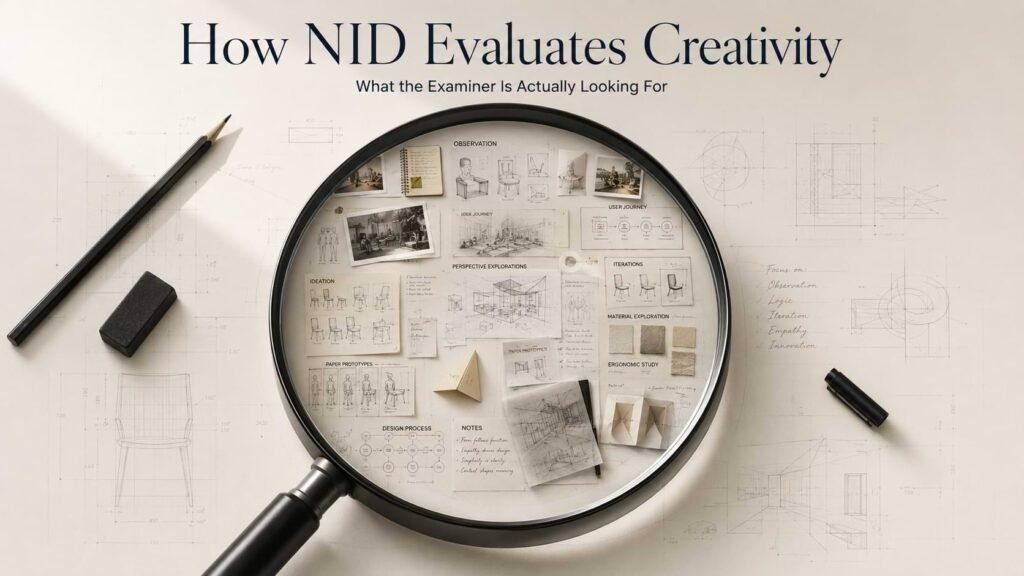
How NID evaluates creativity in exam comes down to three things: original thinking over rehearsed answers, visual clarity of the idea, and how well a candidate connects an everyday observation to a design solution. NID does not score “good drawing” alone – it scores the thought process behind the drawing, which is why two similar-looking sketches can get very different marks.
Every year, thousands of NID DAT aspirants ask the same question in different words – how does NID evaluate creativity what examiner looks for in DAT prelims, and why do equally talented students get such different scores? The honest answer is that NID’s creativity assessment is not mysterious once you understand the framework examiners actually use. This guide breaks down how NID evaluates creativity in exam settings, from the Prelims answer sheet to the Mains studio test, using verified details from NID’s own admissions material and current 2026 exam updates.
1. Understanding NID DAT Marking Criteria
Before discussing creativity itself, it helps to understand the structure examiners work within. The NID DAT marking criteria for B.Des Prelims allot 100 total marks across two parts:
- Part I is objective, covering visual and analytical reasoning, with smaller per-question marks.
- Part II is subjective, made up of open-ended creative tasks worth far more per question.
- There is no negative marking in either stage, so examiners look for what a candidate did right, not for penalizing wrong turns.
- 2026 change: the Prelims score now carries zero weightage in the final merit list – it only qualifies candidates for Mains.
This means the real test of how NID evaluates creativity in exam terms happens later, in the Studio Test, where concept development, presentation quality, problem-solving, and technical execution are marked together rather than as separate boxes to tick.
Also Read – NID DAT Mains Complete Guide: Studio Test, Model Making and Interview – How to Prepare from Indore
2. What NID Examiners Look For in Subjective Answers
So what NID examiners look for when reading a subjective answer or reviewing a studio task isn’t polish – it’s evidence of thinking. In practical terms, what NID examiners look for includes three consistent markers:
- A clear observation the candidate made from real life.
- A logical bridge from that observation to the design response.
- Confident, uncluttered execution rather than decorative detail.
This is also central to how NID evaluates creativity in exam papers where the same prompt is attempted by hundreds of students in one sitting – the ones who stand out are rarely the most technically skilled artists, but the ones with the most honest point of view.
Also Read – NID 2026 Round 1 Seat Allotment: Token Amount Payment, Deadline & Next Steps Explained
3. The NID Evaluation Process – From Prelims to Studio
The NID evaluation process is genuinely two-tiered, and understanding both tiers matters.
- Prelims: Part II questions are read for conceptual clarity within a strict word or space limit – examiners are also silently judging whether a candidate can think and communicate under constraint.
- Mains: the Studio Test replaces the pen-and-paper format with model making, doodling, and storyboarding.
- New for 2026: an In-Person Sensitivity Test checks a candidate’s empathy toward real-world social and environmental situations.
- For M.Des candidates, a portfolio and personal interview are added, together carrying the majority weight of the final Mains score.
Because Prelims is now purely qualifying, the entire NID evaluation process for final ranking rests on Mains performance, making the studio round the true measure of how NID evaluates creativity in exam year 2026 and beyond.
Also Read – NID Studio Test vs NIFT Situation Test
4. Visual Reasoning Scores Differently – Here’s Why
It’s worth addressing this separately because many aspirants over-prepare for it. The NID DAT marking criteria for prelims visual reasoning section reward pattern recognition, spatial visualisation, and quick logical elimination rather than artistic flair – these questions carry smaller individual marks and no negative marking, so accuracy under time pressure matters more than creative interpretation here. Save the creative energy for Part II and for the Studio Test, where it is actually rewarded.
5. NID Scoring Hidden Criteria Nobody Talks About
Coaching material rarely spells out the NID scoring hidden criteria that quietly separate a good sheet from a great one:
- Handwriting and sketch neatness aren’t marked directly, but legibility helps an examiner follow your logic quickly – it buys goodwill.
- Overused, generic ideas (a lightbulb for “innovation,” a globe for “connectivity”) are mentally flagged as clichés even when well executed.
- Restraint is noticed – resisting the urge to cram five ideas into one answer and instead fully developing one reads as more design-mature.
These are the unstated factors experienced mentors try to correct for early in a student’s preparation. (Note: NID has not published an official rubric for these – this section reflects consistent patterns across verified exam-structure facts, not a leaked scoring document.)
6. The One Quality Every Top-Scoring Sheet Shares
Given hundreds of answer sheets on an examiner’s desk, what makes an NID answer sheet stand out from others is rarely a single flashy idea – it is consistency:
- Staying true to one clear concept from the first line to the final sketch, without contradicting itself.
- Labelling, brief annotations, and a title for the concept, which help an examiner grasp intent within seconds.
- Avoiding a brilliant opening idea that fizzles out halfway through the answer.
It is this quiet consistency, more than any single clever twist, that answers how NID evaluates creativity in exam sheets that rise to the top of a stack.
7. NID Examiner Mindset – How Originality Is Judged
Understanding the NID examiner mindset how originality is judged in DAT prelims changes how a student prepares. Examiners compare a response, consciously or not, against the pool of answers they’ve already seen that day – so an idea that felt fresh in a coaching classroom in October may be the fortieth version an examiner reads on exam day. Originality, in this context, isn’t about inventing something no one has thought of; it’s about grounding a common theme in a specific, personally observed detail that couldn’t have come from a template.
Also Read – NIFT Situation Test 2027: What Judges Actually Look For
8. Three Repeat Offenders Every Exam Cycle
Among the common mistakes NID examiners notice in DAT answer sheets, three repeat every year:
- Answering the question that was expected rather than the one that was actually asked.
- Running out of space and leaving the final subjective question incomplete.
- Defaulting to safe, decorative sketches instead of committing to a genuine idea.
Avoiding these three mistakes alone moves a sheet from average to memorable.
9. NID vs Royal College of Art – Two Ways of Judging Creativity
It’s useful to compare NID vs Royal College of Art, since both are globally respected design institutions with very different evaluation philosophies:
- NID: Prelims and Studio Test are timed, on-the-spot creative exercises judging how a candidate thinks under pressure, in a single sitting.
- RCA: evaluates a curated portfolio built over months, followed by an interview, judging imagination, innovation, and growth potential – there is no timed drawing test at all.
This comparison is a useful reminder that “creativity” is never assessed the same way twice; it always depends on what a specific institution values in a working designer.
10. What This Means for Indore and Bhopal Aspirants
For students preparing through NID coaching in Indore or NID coaching in Bhopal, the practical takeaway is the same: mock studio exercises and Part II writing practice under real time limits matter far more than portfolio polish this year, given how NID evaluates creativity in exam terms has shifted toward Mains-heavy scoring.
Frequently Asked Questions
Q1. How does NID evaluate creativity in the DAT exam?
How NID evaluates creativity in exam settings depends on the stage – Prelims Part II rewards clear, original conceptual thinking under space constraints, while the Mains Studio Test rewards hands-on execution, empathy, and design maturity, with Prelims now serving only as a qualifying filter.
Q2. What do NID examiners actually look for in the studio test?
They look for genuine problem understanding, an honest point of view, and confident execution over decorative skill – the same qualities that define how NID evaluates creativity in exam rounds generally.
Q3. Does handwriting or sketch quality affect NID scoring?
Not directly, but as part of the NID scoring hidden criteria, legibility and clean presentation help an examiner follow the idea faster, which works in a candidate’s favour.
Q4. Is NID’s evaluation similar to Royal College of Art’s?
Not really. The NID vs Royal College of Art comparison shows NID leans on timed, in-person creative tasks, while RCA relies on a long-term portfolio and interview.
Conclusion
Ultimately, how NID evaluates creativity in exam terms is less about talent and more about clarity, honesty, and knowing which stage rewards what. Candidates who understand how marks are actually awarded, avoid the common mistakes examiners flag every year, and practice under real exam constraints consistently outperform those chasing “creative” tricks. Design Aspirants’ Indore and Bhopal batches build their studio-test practice and Prelims writing drills around exactly this examiner framework, so students walk in already thinking the way NID wants them to think.